Saturday, March 16, 2013

Burrowing Owls -- Ya Gotta Love Them!

While visiting my daughter in South Florida last week I took two opportunities to visit the Burrowing Owls at Brian Piccolo Park not just once, but twice.

I think I've already posted about what a great site this park is for these adorable little creatures and this time proved no different.

The first day I dragged her friend Roy with me. Alana (my daughter) was busy and he wasn't. I don't think he expected finding and viewing the owls to be so easy. You simply look for the cordoned off areas. Most of them are right next to parking lots and sports fields. A few days later it was Alana's turn.


 Both days (unlike the last time I went with Avi) most of the Owls were out in the open, sitting by their burrows. There was even a pair, making me wonder about possible owlets.


A nice surprise was a couple of Common Yellowthroats hanging around the garden area in front of my daughters condos. I wondered if they were just passing through on migration. But I saw them every day I was there.


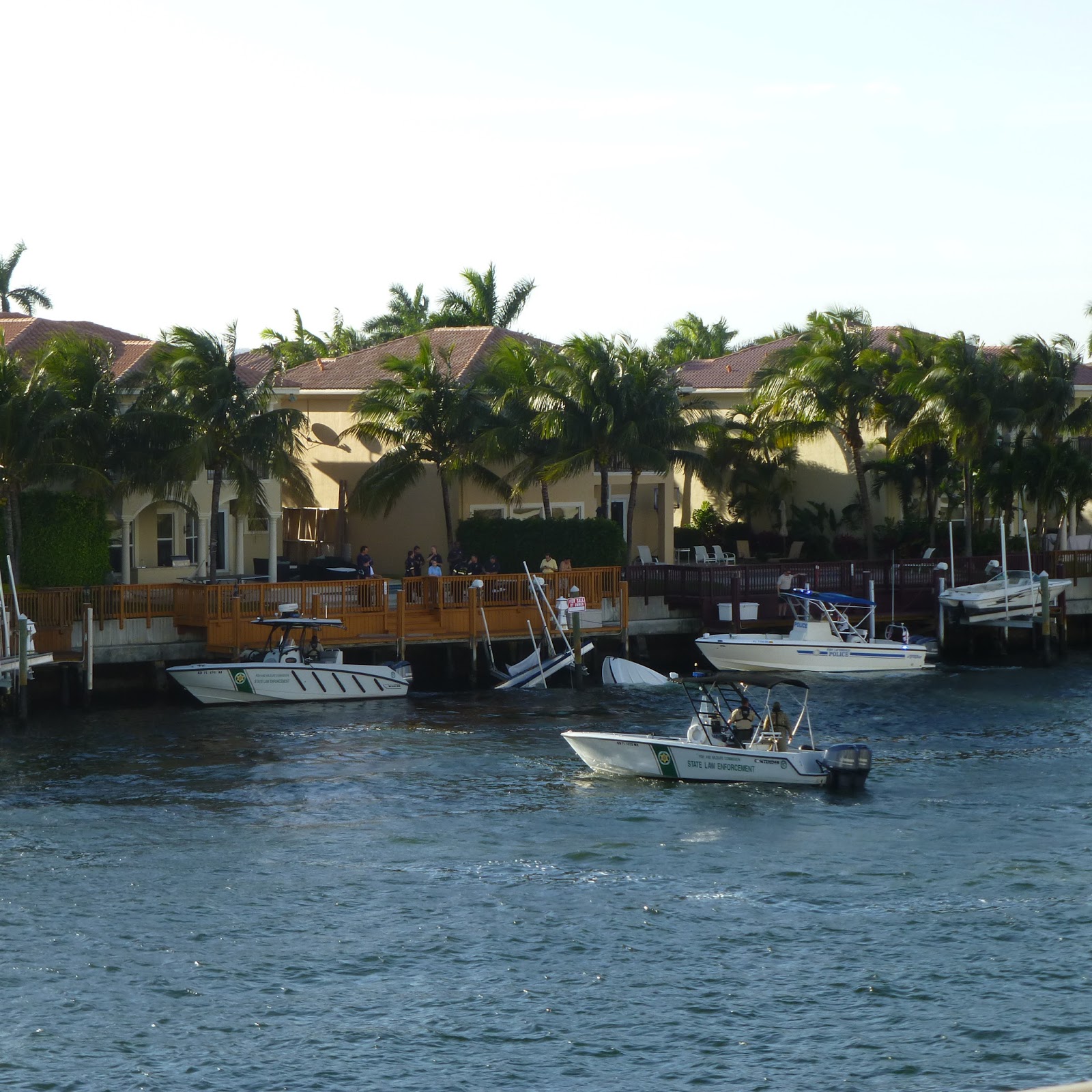
 We also had a little bit of excitement during the last day of my visit. A boat on the other side of the intracoastal had fallen off its raised mooring and sank. We watched while the Fire Rescue, Hollywood Water Police, and Florida Fish and Wildlife officials all came. I won't be there to see how that story works out. Hopefully Alana can fill me in.


 Of course, the cuteness of the Owls trumped all; so I leave you with a few more shots of these little birds.


Monday, February 18, 2013

Snowy Owl Mug: Results

Remember I spoke about making a mug using a Snowy Owl's face? Just thought I'd share the results. Incidentally, the mug sold quickly, so I see myself making more in the near future.


Also, here's a shameless plug for my online shop, which always has several bird mugs in addition to a lot of Judaica: http://agru.etsy.com

Tuesday, February 5, 2013

Banding Birds in Seattle

As you know from the previous post, I was in Seattle to visit my son. However, he had tickets for Book of Mormon in Portland, so would be out of town for a couple of days.

Being the best son I have (also the only one), he hooked me up with Emily Runnells, and ornithology major at U. Washington, and a volunteer bander with the Puget Sound Bird Observatory. She picked me up early and we drove out to the Shoreline area in Seattle.

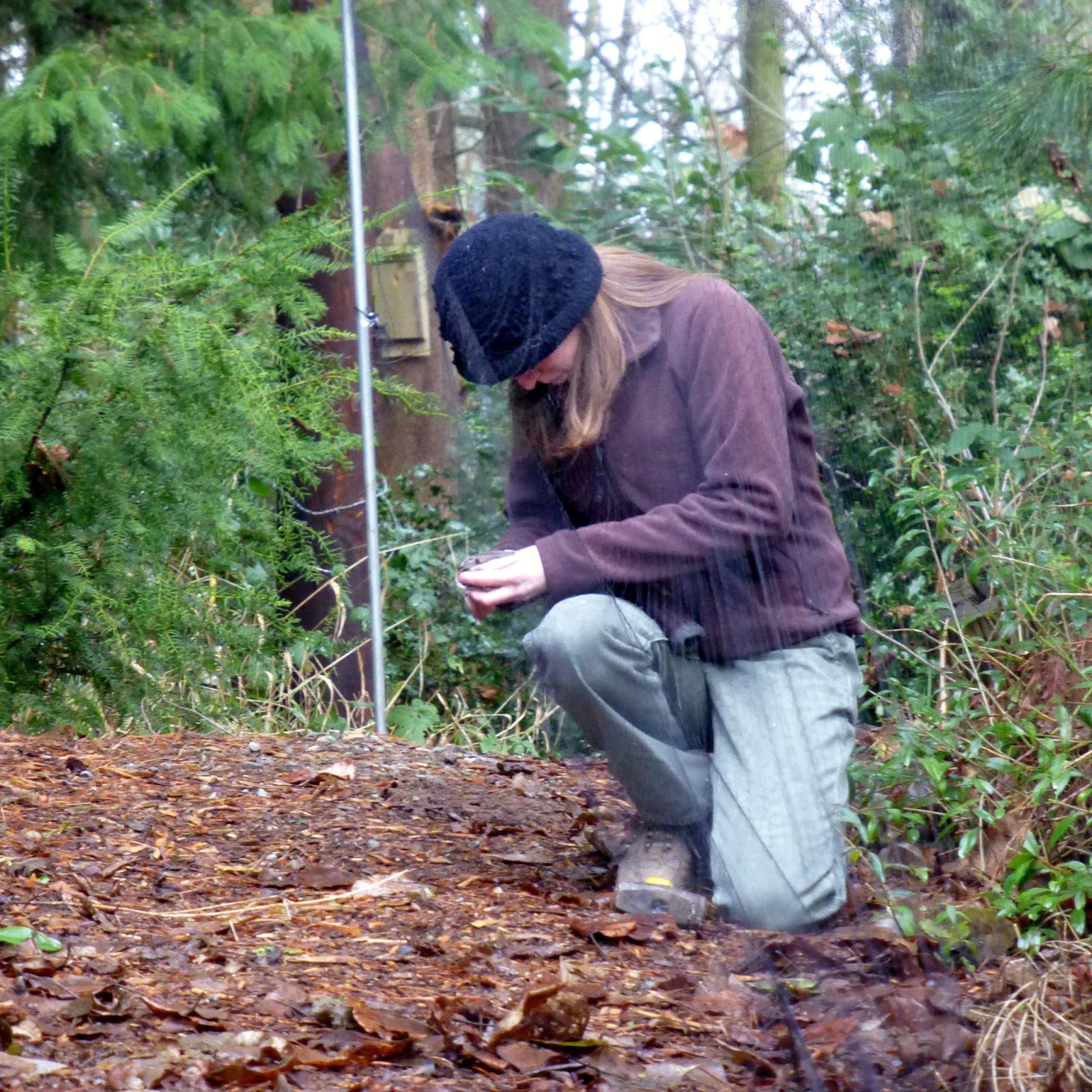
It turns out the banding station is at the head bander's house. Four mist nets were stretched out in her backyard and side yard. Since it was cold out, volunteers were going back to take the birds from the nets every ten minutes.


 Birds were "held" in small cotton sacks and hung on a line in the order in which they had been caught. The team tried to process birds quickly, since they could become hypothermic if exposed to the cold too long without food or movement.


However,  there was a heat lamp and a warming box in case the birds were less than responsive after being banded and processed. I saw two or three birds placed back in their little bags and put in the heating box. After a few minutes you could see their recovery, as they quickly flew off when released.


The first part of processing a bird is the banding. There are several different-sized bands to fit different leg diameters. The idea is to have the band snug enough to stay on and not irritate the bird, but not so snug that it would cause friction or constriction. Each band has a unique identification number which goes into a national database, in case the bird is recaptured or found after it has died.


Once the band is on (in case it escapes before the rest of the data can be recorded), the bird is processed by collecting a variety of data. Below, split between two photos) is the data collection sheet. There is one sheet for each size band, which usually groups the same species of birds on that sheet as well.


 I helped record the data, which became challenging when two or three banders were giving me their birds' information at the same time.


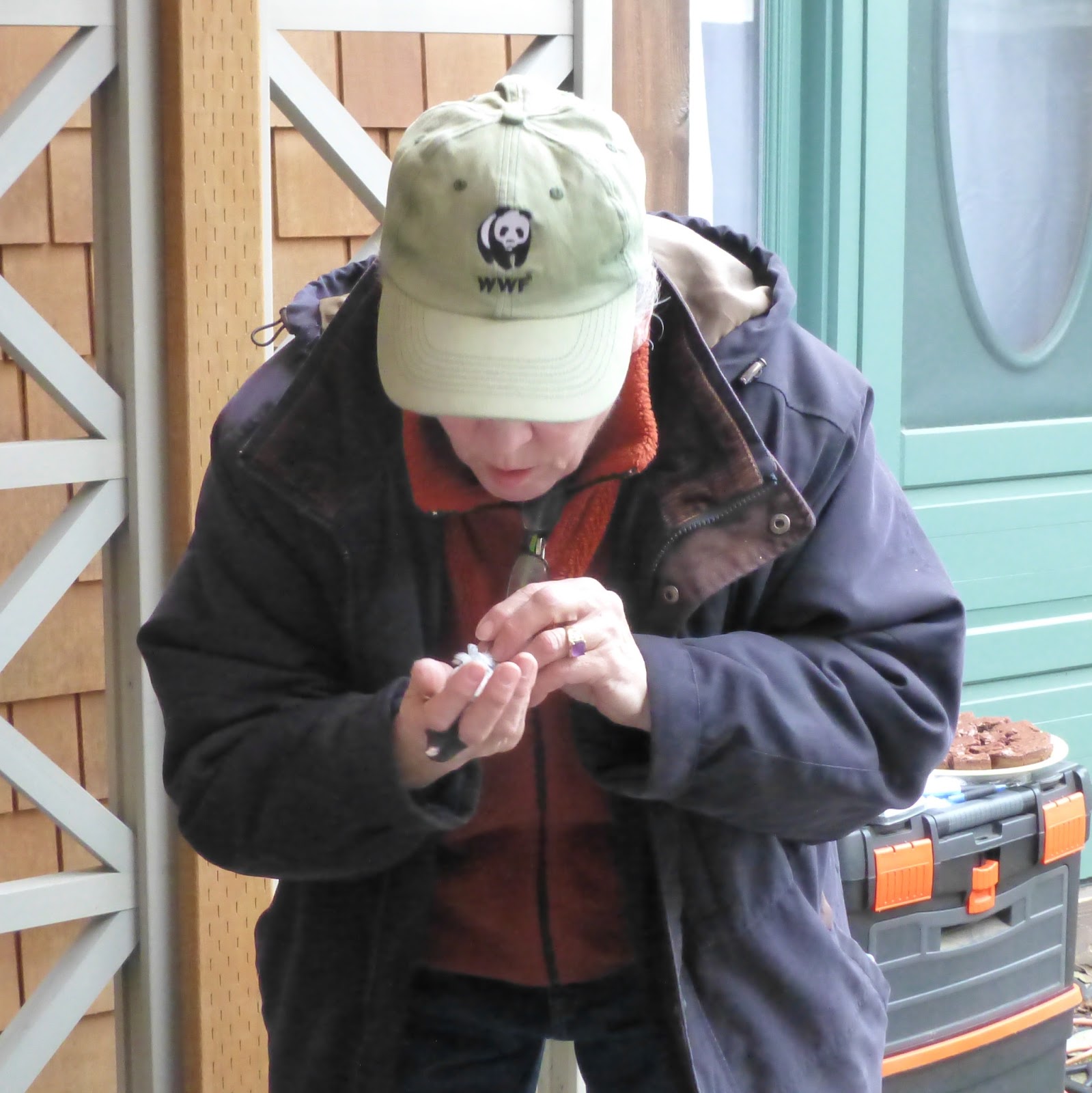
In the above photo, Cathy is blowing on a Dark-eyed Junco's breast feathers to reveal the skin underneath and estimate how much fat the bird has. At the same time she can check it for any parasites.

Below, the Junco reveals some wear in its wing feathers. The second photo shows how the wing should look. Can you tell the difference?


It's also nice to have a close look at the markings on its tail feathers!


Another measurement is the wing chord, the length of the longest primary feather. Here a Pine Siskin is being measured.


As a "thank you" for helping, I got to release a Dark-eyed Junco.


One of the two "best" birds of the day was a Townsend's Warbler. This would have been a life bird for me. However, Avie and I saw one several years ago in Anzalduas Park in the Lower Rio Grande Valley. Nevertheless, she is a beautiful bird and we all turned into paparazzi, snapping plenty of photos before she was released.


A Spotted Towhee was the largest bird we netted. Here's a great look at the "spots".


But, by far, the handsomest bird of the day was this textbook-perfect Red-breasted Nuthatch. The cameras were snapping away with him.


You have to love the detailing on the tail feathers here!

I think all birds look like "Angry Birds" when photographed face on.
 So, a big THANK YOU to my son Dan, for arranging my outing, to Emily, for being my guide and chauffeur, and to lead bander Cathy, for allowing me to join them.

Saturday, January 12, 2013

Some Time in Seattle, Skagit/Samish Flats

In spite of doom and gloom weather predictions on the part of my son, I decided to pay him a visit between xmas and the week after New Year's, splitting my time among him, coffee in the great Seattle coffee shops and him, and some quality winter birding with him.

As you can see from the photo below, rather than doom and gloom, the weather, for the most part, was sunny and clear, albeit rather cold.

Mt. Ranier from the air, as I flew into Seattle
Our first stop, literally, was in Ballard (an area in Seattle proper). I had been reading ongoing reports of Snowy Owls there.

Dan asked, "How are we going to find them?"

"We're looking for a large group of people with binoculars, looking up," I answered.

Sure enough, within a couple of minutes, we found the group and one of the two reported Snowy Owls.


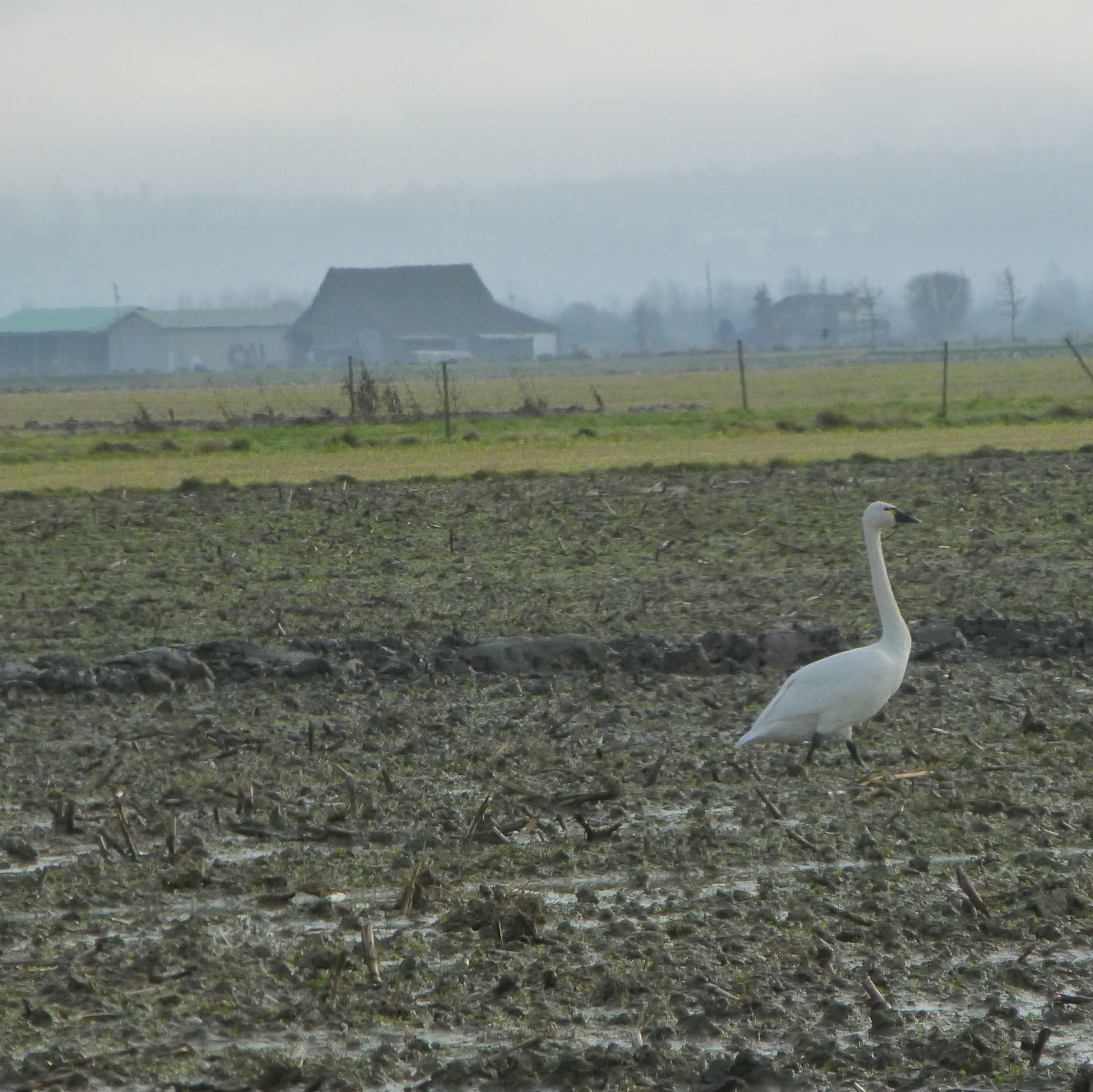
After a day to get situated, we drove out to Skagit and Samish Flats, an area recommended to me by Bob Doe, a San Antonio birder. The flats are about a 40 minute drive from Seattle and consist of mostly farmland. We were on the hunt for Swans, Geese, and Raptors.

Along the way I snapped a photo of a scene Dan (my son) refers to as "the curtain". I'm sure you can see why.


Our guide was the Birder's Guide to Washington, by Opperman. We'd used this guide before with great success.

Our first stop was an area by the water. It was hunting season and I think we were the only people parking there without camouflage and hunting gear. Shots were being fired nearby, so we remained fairly close to the parking lot, not wearing any flame orange.


Our first birds of the day were a Bald Eagle and some lovely Oregon race Dark-eyed Juncos. As the day went on and we drove around the farmland, we ticked both Tundra and Trumpeter Swans (the latter being a life bird for me), Brant, Snow Goose, Greater White-fronted Goose, and Great Blue Heron.


Our first raptor of the day was a Peregrine Falcon, posing nicely in a tree.


In between birds, we enjoyed the changing scenery and picturesque scenes around us.


We also enjoyed the variety and frequency of raptors in the area, including the usual Bald Eagle and the not-so-usual for me Rough-legged Hawk. What on earth would we birders do without overhead electric and telephone lines?


Probably the highlight of my day were the Short-eared Owls flying around in two different areas. We were even able to watch a pair in bonding flight, flying together, touching talons, and wheeling apart. I was able to get an accidentally wonderful shot of one of the owls taking flight after eating some prey.


The birding on the Flats was superb. The only problem was the brevity of Seattle's winter days. By 3:30 p.m. it was already beginning to get a bit dark. I fully intend to return to Seattle next winter to get out to this spot again. I need a Gyrfalcon and a Northern Goshawk. Perhaps next time I'll get lucky and add one or both of them to my life list.

Before giving you the day list, I leave you with my favorite photo of the day.

The list:

Monday, December 24, 2012

Avenue A - Dec. 24, 2102

It was too perfect a day to just sit around, so we decided to take a morning birding walk along River Road and Avenue A here in San Antonio.

The area was the birdiest it's been in recent memory, giving us 27 species of birds. They were all in pockets of mixed flocks, and mostly where there was an abundance of berries and seed grasses.

I think our favorite birds of the day were a pair of Red-breasted Nuthatches foraging near each other. There seems to be a larger number of these in the area this winter and I'm enjoying every encounter.

Also delightful was seeing a White-eyed Vireo and a Blue-headed Vireo. They're both very pretty birds and it's always a treat to see the former.

I took a few photographs by the levee area and am posting them below, followed by the day's list. (I know I took some photos of a Great Egret, but they seem to have disappeared sigh!) Enjoy!

Red-tailed Hawk in flight.


Red-tailed Hawk perched before being mobbed by Mockingbirds and Blue Jays.

Couch's Kingbird

Couch's Kingbird
The list:

Choke Canyon - Dec. 23, 2012

With a long weekend and beautiful weather, we decided it was time to take a trip down to Choke Canyon State Park. Our friends from New Jersey, Gordon and Nancy joined us.

It being the Sunday before Xmas, FM 99, usually busy with large semi trucks from the Eagle Ford oil projects, was empty enough to allow us some "old time" birding. Though not as birdy as in the past, it still gave us a good start to the day.

Disappointment hit when we reached the Choke Canyon reservoir areas near the intersection of 99 and 72. They are virtually dried up, with virtually no habitat for the usual ducks, shorebirds, kingfishers, cormorants, anhinga, etc.

However, the area wasn't totally devoid of interest. We saw a bird of prey in the distance, which I desperately wanted to turn into a Bat Falcon because of its bright coloration. It turned out to be a magnificently colored juvenile Northern Harrier, which became apparent when we saw its owl-like facial disks through the scope.

I also managed to get a great shot of a Double-crested Cormorant, certainly not an unusual bird for the area, but posed perfectly for me to use for one of my bird mugs at a future date. (Advertisement: You can find my pottery here.)

Birding in the park was good. The parking lot by the old swimming pool had a Vermilion Flycatcher on every tree, most of them fully feathered males.

The nearby Bird Trail was also active, with mixed flocks of Blue-gray Gnatcatcher, Black-crested Titmouse, Orange-crowned Warbler, and Ruby-crowned Kinglets. At the back end of the trail, by the water pumping area, we had our "difficult" bird of the day. (You need at least one or your trip hasn't been worthwhile, say I.)

It was a Kingbird, but was much too light for it to easily be counted as a Couch's Kingbird, the most likely in the park this time of year. The three of us who saw it all agreed it was right for a Western Kingbird; but they aren't supposed to be there in December. Unfortunately, I didn't have a chance to photograph it, so it might well remain a conundrum, unless someone refinds the bird.

Once again, as in our past several visits, Olive Sparrows were nowhere to be seen. I wonder if the prolonged drought has affected their habitat that much?

As usual, butterflies caught our eye and I managed to get photos of two different species: 

Queen

 
I'm not sure what type of butterfly this is.
From there, we drove over to 75 Acre Lake, where there were interesting birds -- just on the opposite shores. However, with the scope, we were able to see well enough through the late morning heat shimmer to identify a good number of ducks, shorebirds, and a couple of Harris's Hawks.

The interesting birds here were four Black-winged Stilts past their season (though not as unlikely as that Kingbird!).

We also saw the good-sized Alligator that tends to inhabit this body of water.

After a quick drive through the RV area, with nothing of interest, we drove to the exit of the park and came upon about six Northern Bobwhite by the side of the road. Three flew off as we approached. The remaining three seems unbothered by my photographic efforts, the best of which I share below.

And, before the day's list, I leave you with one of the park's mammals, reaching young adulthood.

 
The list:

Sunday, November 11, 2012

SA Audubon Field Trip to Choke Canyon

Unfortunately, I forgot the camera today. Of course, there were a couple of great videos I missed. But, such is life.

Since I have no accompanying "illustrations", I'm going to keep this short and sweet. Birding was patchy, with areas of good birding interspersed with long periods of time with no apparent birds or birds giving chip calls, but not allowing us to see them.

The best birding areas today:
  • The parking lot near the swimming pool, giving us Couch's Kingbird, Great Kiskadee, Green Jays, Cooper's Hawk, and both listed Woodpeckers, among others.
  • The first part of the birding trail and then the second section (after the jog and just before where the wetlands used to be), with several Blue-gray Gnatcatchers, Ruby-crowned Kinglets, Yellow-rumped Warblers.
  • 75 Acre Lake, especially scoping the far shores from the trail between the two bodies of water
 The non-birding highlights (which made me yearn for the camera) were:
  • Two Dung Beetles rolling their balls of dung. I love to watch these creatures using their rear legs, while doing their work head down.
  • We heard an unusual noise a bit down the trail. It was coming from a Cottontail Rabbit which had been nabbed by a large Indigo Snake. We watched with morbid fascination while the rabbit struggled and the snake worked against its struggle. I won't go into any more detail. The most interesting thing I saw during the struggle was the snake shaking its tail, as though it was a Rattlesnake. Avie has some video -- we just can't figure out how to get it off his phone.

All in all, not the best of days. But not too shabby either, with 47 species of birds.

Gadwall
Blue-winged Teal
Northern Shoveler
Scaup sp.
Wild Turkey
Neotropic Cormorant
Double-crested Cormorant
Great Blue Heron
Great Egret
Snowy Egret
Little Blue Heron
Tricolored Heron
White Ibis
White-faced Ibis
Roseate Spoonbill
Black Vulture
Turkey Vulture
Osprey
Northern Harrier
Cooper's Hawk
Harris's Hawk
Red-tailed Hawk
Crested Caracara
American Coot
Sandhill Crane
Rock Pigeon
Eurasian Collared-Dove
Golden-fronted Woodpecker
Ladder-backed Woodpecker
Eastern Wood-Pewee
Eastern Phoebe
Vermilion Flycatcher
Great Kiskadee
Couch's Kingbird
Loggerhead Shrike
White-eyed Vireo
Green Jay
Ruby-crowned Kinglet
Blue-gray Gnatcatcher
Northern Mockingbird
European Starling
Yellow-rumped Warbler
Savannah Sparrow
Red-winged Blackbird
Western Meadowlark
Great-tailed Grackle
Brown-headed Cowbird