Showing posts with label birding survey. Show all posts

Tuesday, February 5, 2013

Banding Birds in Seattle

As you know from the previous post, I was in Seattle to visit my son. However, he had tickets for Book of Mormon in Portland, so would be out of town for a couple of days.

Being the best son I have (also the only one), he hooked me up with Emily Runnells, and ornithology major at U. Washington, and a volunteer bander with the Puget Sound Bird Observatory. She picked me up early and we drove out to the Shoreline area in Seattle.

It turns out the banding station is at the head bander's house. Four mist nets were stretched out in her backyard and side yard. Since it was cold out, volunteers were going back to take the birds from the nets every ten minutes.

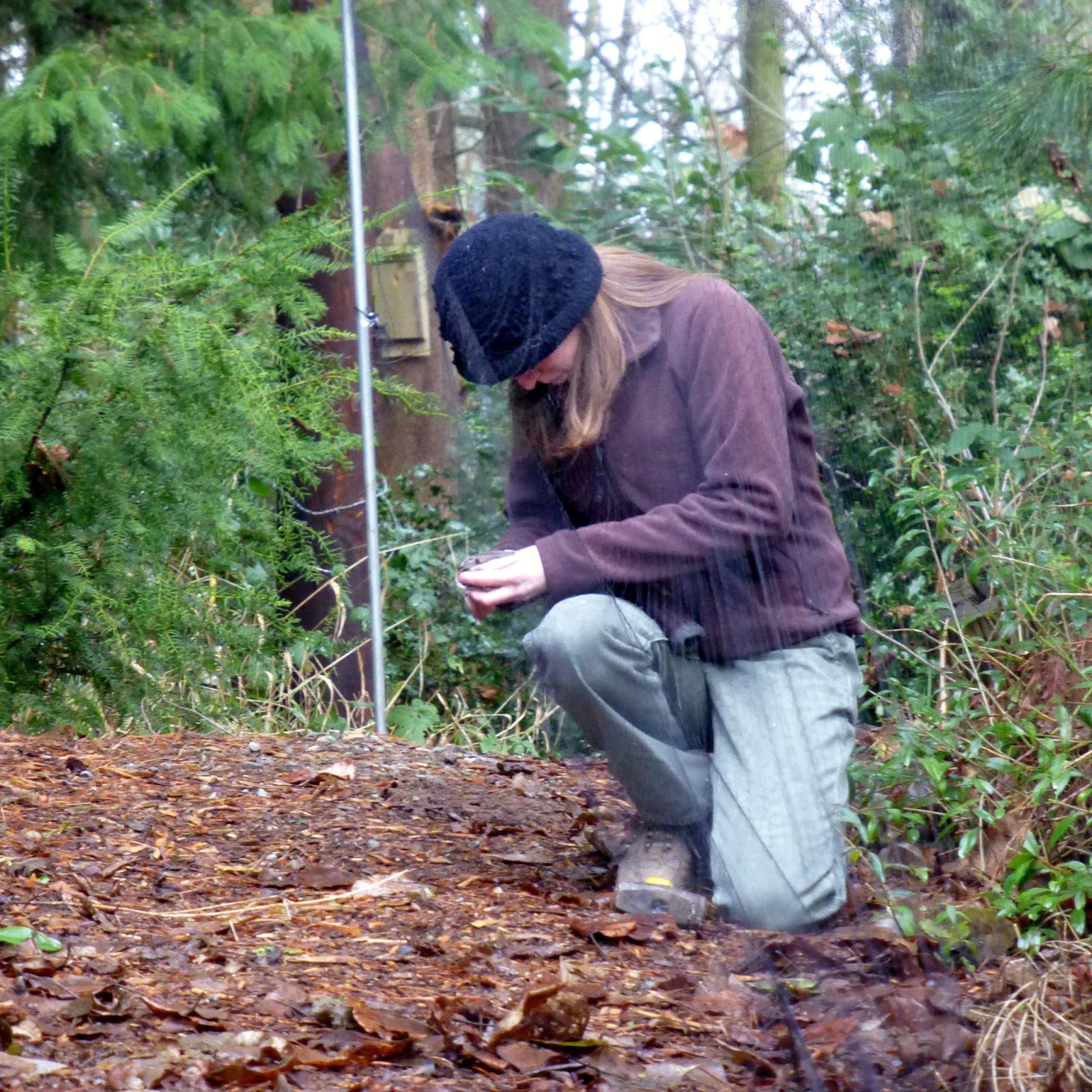


 Birds were "held" in small cotton sacks and hung on a line in the order in which they had been caught. The team tried to process birds quickly, since they could become hypothermic if exposed to the cold too long without food or movement.


However,  there was a heat lamp and a warming box in case the birds were less than responsive after being banded and processed. I saw two or three birds placed back in their little bags and put in the heating box. After a few minutes you could see their recovery, as they quickly flew off when released.


The first part of processing a bird is the banding. There are several different-sized bands to fit different leg diameters. The idea is to have the band snug enough to stay on and not irritate the bird, but not so snug that it would cause friction or constriction. Each band has a unique identification number which goes into a national database, in case the bird is recaptured or found after it has died.


Once the band is on (in case it escapes before the rest of the data can be recorded), the bird is processed by collecting a variety of data. Below, split between two photos) is the data collection sheet. There is one sheet for each size band, which usually groups the same species of birds on that sheet as well.


 I helped record the data, which became challenging when two or three banders were giving me their birds' information at the same time.
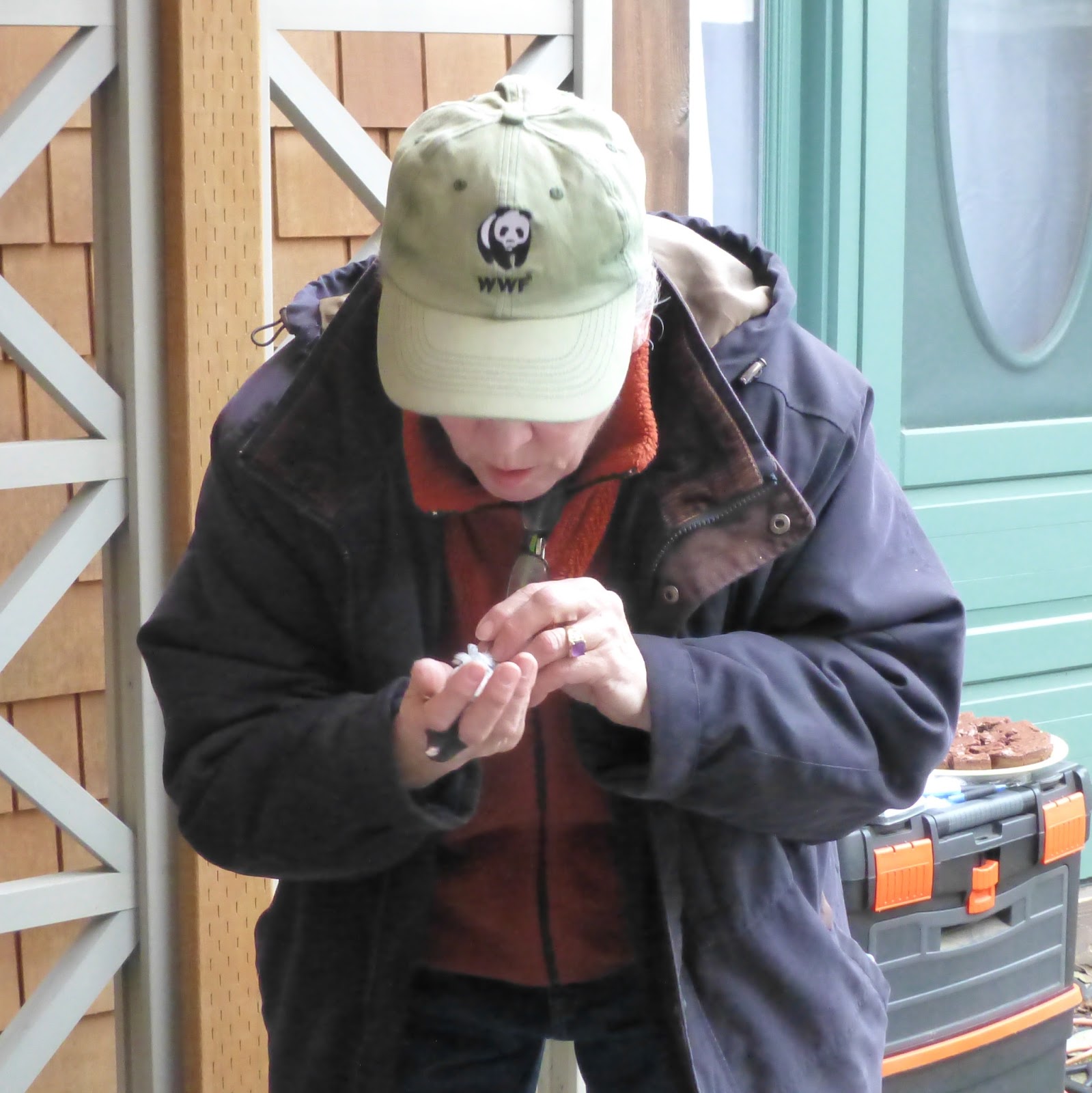

In the above photo, Cathy is blowing on a Dark-eyed Junco's breast feathers to reveal the skin underneath and estimate how much fat the bird has. At the same time she can check it for any parasites.

Below, the Junco reveals some wear in its wing feathers. The second photo shows how the wing should look. Can you tell the difference?


It's also nice to have a close look at the markings on its tail feathers!


Another measurement is the wing chord, the length of the longest primary feather. Here a Pine Siskin is being measured.


As a "thank you" for helping, I got to release a Dark-eyed Junco.


One of the two "best" birds of the day was a Townsend's Warbler. This would have been a life bird for me. However, Avie and I saw one several years ago in Anzalduas Park in the Lower Rio Grande Valley. Nevertheless, she is a beautiful bird and we all turned into paparazzi, snapping plenty of photos before she was released.


A Spotted Towhee was the largest bird we netted. Here's a great look at the "spots".


But, by far, the handsomest bird of the day was this textbook-perfect Red-breasted Nuthatch. The cameras were snapping away with him.


You have to love the detailing on the tail feathers here!

I think all birds look like "Angry Birds" when photographed face on.
 So, a big THANK YOU to my son Dan, for arranging my outing, to Emily, for being my guide and chauffeur, and to lead bander Cathy, for allowing me to join them.

Friday, February 18, 2011

We Have Travel Packets!

Yesterday (Thursday, Feb. 17), a week and a half before we’re scheduled to fly from Miami to Havana, we received emails from Marazul (the travel “agents”) asking us to confirm the use of our pre-authorized credit cards and our mailing address. A second email notified us our travel packets were going out that evening.
Well, it’s just before 1:30 p.m. on Friday, Feb. 18 and they’ve arrived. My level of anxiety regarding the unknown travel factor has disappeared.

A photo of my portion of the packet is below. Avi received identical papers, except with his name on everything.

Travel Packet

It contained:

1. Our tickets for our flight booked by Marazul, chartered by Gulfstream Air, and provided by Sky King. The guessing game we’ve been playing these past few days about the type of aircraft we’d be on has been resolved as well. We’ll be flying a Boeing 737 with an allowance of 44 lbs. each. I’m anticipating we’ll be at 44 lbs. combined, since we prefer to travel light. ($349 each R/T)

2. A travel contract between us and Gulfstream Air, which we have to sign and hand in at the Miami airport.

3. Our Cuban Tourist Card, which cost $50 each.

4. A paper giving us information regarding our Cuban health insurance, which we are required to purchase in order to visit Cuba. Apparently we have $25,000 worth of coverage each, with $7,000 more for transportation home in the event of injury or death. All this for $3/day.

5. Our license from the U.S. Dept. of the Treasury, making this a legal trip for humanitarian purposes.

6. Information on Cuban money exchange. Between the exchange rate and the exchange “premium” (thanks to the U.S. embargo discouraging U.S. dollars from entering Cuba), there’s a 20% loss when exchanging dollars for CUC’s. We could exchange our dollars into Euros here and then into CUC’s. But it all seems too complicated, and I’m not sure there would be that much in savings. We’ll see what we decide when we read this a bit more carefully.

7. A 17 page booklet from the U.S. Office of Foreign Assets Control titled Cuba: What You Need to Know About U.S. Sanctions Against Cuba. A pretty dry read. Most of the material doesn’t apply to us. It just speaks about who may or may not travel to Cuba and what we may and may not purchase there. At least it looks as though Avi can bring back some music.

This weekend we’ll be getting things out and in order for packing. It seems particularly important we not forget anything we need, since we’re not allowed to buy much in Cuba.

Monday, February 14, 2011

Next Stop: Cuba!

Many, many months ago, just after our return from our birding trip to Ecuador (Galapagos), Andy Griswold from the Ct. Audubon Society's Ecotravel decided to try and tempt us into booking another trip. First he sent us information on their trip to Trinidad and Tobago -- it look interesting, but we decided it was a bit too rich for our blood. But Andy is a smart man. The next offer hooked us and reeled us in. It was a two-week birding survey of Cuba in conjunction with the Caribbean Conservation Trust.

Perhaps a little bit of backstory would be in order here. I used to have family in Cuba. My grandmother had two aunts who lived there and ran a, um, er, "business" in Cienfuegos or Matanzas. (Both areas came up when she would tell the story.) My grandmother visited her aunts there before Batista was deposed and frequently told us it was the most beautiful place she had ever been. I have several photos from her time there, but will post just one, since I think it's the most historically significant (check out the poster to my grandmother's right).

Basically, the poster says:

Workers
We march on May 1st
United front to the divisionists (?) and against anti-union attacks!


We signed up. The process hasn't been an easy one.

We're flying in and out of Miami through a Cuban charter company called Marazul. We ARE traveling legally, with a license from the U.S. Treasury Dept. since this is considered a scientific trip which falls under humanitarian travel. As of now, I'm still not sure everything is in order, since we have yet to receive our travel packet: airline tickets, Treasury license, proof of Cuban health insurance (required of all foreign visitors at a cost of $3/day per person), and who knows what else. With only two weeks before our trip, I must say I'm a bit nervous.

I guess our target bird should be Cuba's most famous, the Bee Hummingbird -- about the size of a quarter. But I'd really like to see the Cuban Tody, a very cute, brightly colored piece of feathery fluff (and probably one we're much more likely to see).

Our trip to and from Florida will also include a visit with our daughter, who is living in Hollywood and will be our means of transportation to the Miami airport on March 1. We'll probably get in a bit of birding there as well, though not as concentrated an effort as the two weeks which will follow.

So, stay tuned. I'm pretty sure there won't be much Internet access during our time on the island. But I'll be keeping my journal and logging the photos each day so I can post gradually once we arrive back in the U.S. For now, I'll leave you with one more photo with my grandmother and her cousin (the daughter of one of the Cuban aunts who was raised as her sister in the U.S.) with some Cuban friends.