Showing posts with label birdwatching. Show all posts

Friday, August 16, 2013

Biggest Week Redux

It's been a quiet birding summer. But I realize I never posted additional photos of our visit to Ohio for the Biggest Week in American Birding.

Rather than go on and on, I'll just post some of my favorite photographs from that week with limited commentary.

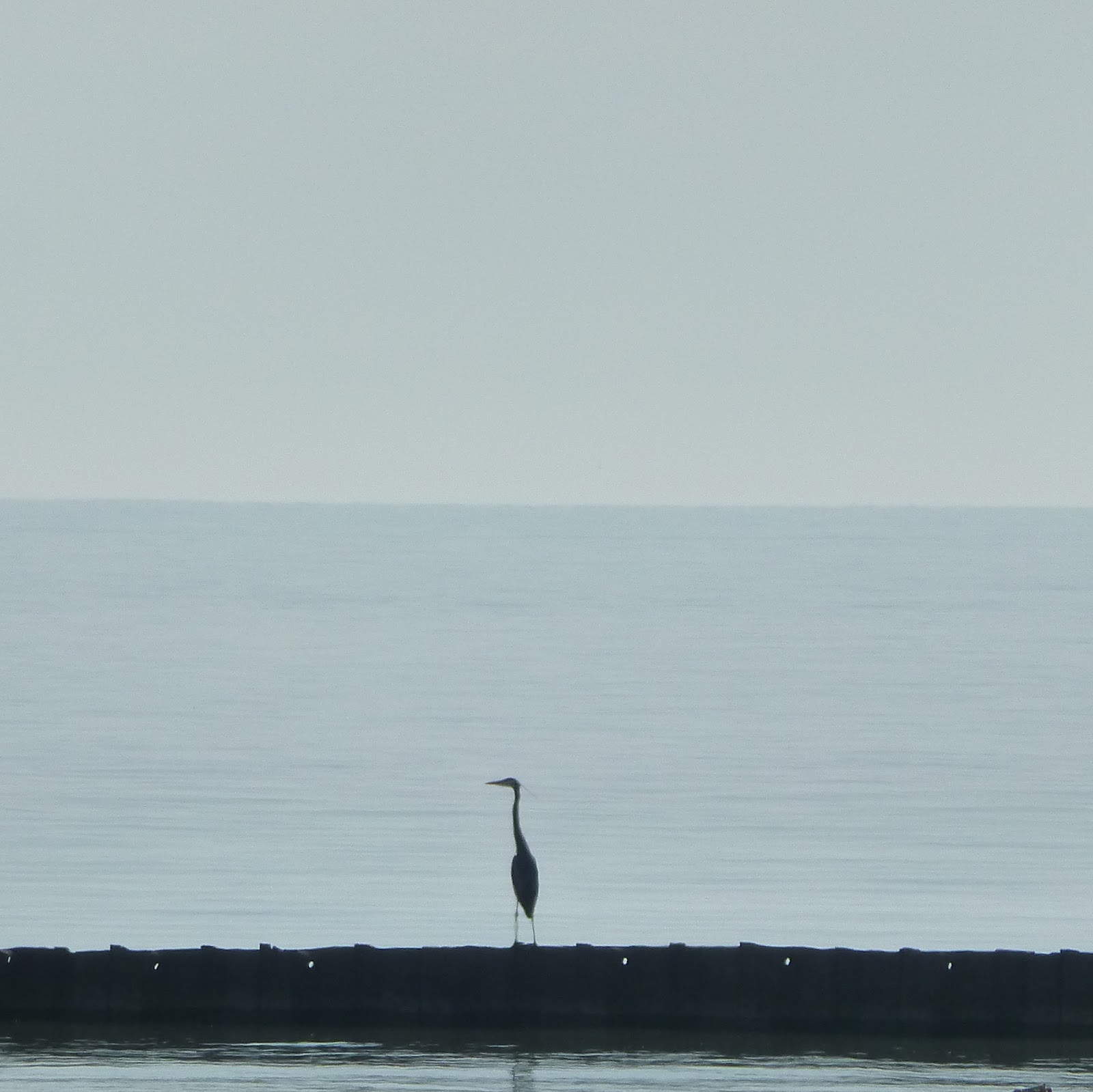
Great Blue Heron against Lake Erie

Tundra Swan

I believe this is a Northern Green Frog

Probably the best bird of the trip, a Long-eared Owl, which was a lifer for Avie and me.

This is what happens five minutes after someone tweets there's a Long-eared Owl

Donald and Lillian Stokes and Kimberly and Kenn Kaufman

Sharon "Birdchick" Stiteler

Scarlet Tanager

How often can you get this awesome a shot of an American Woodcock?

Baltimore Oriole

Midday siesta
Happy birding, everyone!

Monday, May 13, 2013

Birding Big Bend in Late April

Avie and I have wanted to revisit Big Bend National Park since the Southwest Boogie we took a few years ago. This year it seemed like we had the time and, with our newer Toyota Highlander, the clearance for a visit which would allow us access without endangering our car or our heads. 

We invited our friend Mark along, made reservations at the Big Bend Resort and Adventures in nearby Terlingua (the Chisos Lodge in the park was booked up), and headed off to Big Bend on Friday morning, arriving in the early afternoon.

Driving into the park we were greeted by a desert in bloom. There were flowers of all different colors at all different heights. Quite a change from the last time we were there.


I had used A Field Guide to Birds of the Big Bend by Roland Wauer as a directional beacon for this enormous park. It was a good guide to the optimal birding spots. This was especially important because our time was short, amounting to only two days (an afternoon, a full day, and a morning).

We spent most of our birding time around the Rio Grande Village, nearby Daniels' Ranch, up around the Chisos Mountain Lodge, Cottonwood Campground, and Sam Nail Ranch. The first afternoon we made the mistake of taking the "Nature Trail" by the Rio Grande Village. I really should have known better. However, even though we saw few birds, there were still interesting things to be seen.

The first was a Ground Squirrel busily digging its burrow right off the trail.


 The second was a couple of unattended "shops" set up along the trail. They consisted of a few craft items, a small sign with prices on it, and a jar for the money. There are signs in the park warning you it's illegal to purchase items from vendors who illegally cross over to the U.S. side from Mexico. I imagine this is the vendors' way around the system. You aren't actually purchasing FROM them, since they aren't around. You're simply putting money into a jar in exchange for some found items.


At the Daniels' Ranch area we were forced to contend with a large number of sparrows in the grass. We forged ahead, naming as many as we could and taking photos (albeit not very good ones) of others, which we later worked on over lunch or dinner. I think we got most of them and they're in the trip list at the end of this post.

Of course, there were many birds which were much easier to identify.

Greater Roadrunner

Female Vermilion Flycatcher on Nest

Gray Hawk

Cactus Wren (above) and Lark Bunting (lower right)
Vermilion Flycatcher
Golden-fronted Woodpecker
Say's Phoebe Nest by Chisos Mt. Lodge
Wilson's Warbler
Here's a photo of Avie and Mark. We must have just seen a good bird because they're looking awfully happy!


Below is a photo of a Cactus Wren's nest up by the Chisos Mt. Lodge. They're a rather messy affair. However, they must serve their purpose since we saw several of the Wrens around the park.


Of all the blooms in the desert, I think my favorite were the flowers on the Ocotillos. They're a brilliant orange-red and they tower above the rest of the plants, swaying in the wind.


Our best stop of the trip was at the Sam Nail Ranch, where there's a watermill supplying a water drip to the birds. Water in the desert (or anywhere, for that matter) is always a draw for birds. We had heard the birding there was quite active and there was at least one Varied Bunting there.

The first time we stopped up there a birding tour group had just seen the Bunting and, rather than leave the area quietly and celebrate once they were out of range, they were all giving high fives, sharing their photos, and talking loudly. Needless to say, we saw no birds that particular time.

We returned the next day. It was much quieter and the birds were active. In addition to great looks at Varied Bunting, and we think there were two, we also saw Green-tailed Towhee. Two lifers in an hour isn't too shabby.

Here we are after that successful stop.


Saturday night we went into Terlingua Ghost Town for dinner at the Starlight Restaurant and Theatre. On the way we stopped at the old cemetery. Many of the people there had died during the influenza epidemic during 1919-1920's.


The restaurant was crowded with locals and tourists. The food was quite good and the band was great.


Now for a few filler photos of some interesting and/or beautiful things I was able to photograph.

What's left of the front end of a Scorpion

Unidentified desert blooms

Cholla in bloom
If you want to bird Big Bend (and we WILL be back), I do have some important advice to offer.

  • Always be aware of how much gasoline you have in your tank. Distances in the park are great and the availability of gasoline is sparse.
  • Carry more water than you think you'll need and drink it. You're sweating in the desert, but it's evaporating before you feel it. It's very easy to become dehydrated.
  • Don't count on your cell phone. We had little to no reception in the park and spotty reception elsewhere.
  • Sunscreen! Even better, cover up with long sleeves, light pants, and a hat.
  • Bring layers. The desert might be hot, but up in the mountains it can be quite cool.

Now I leave you with something outside Big Bend. This is a photo of part of a Prairie Dog town just outside Marathon, TX. If you're driving out of Big Bend north, it's on the right side of the road.

And now, The List:
Saturday, March 16, 2013

Burrowing Owls -- Ya Gotta Love Them!

While visiting my daughter in South Florida last week I took two opportunities to visit the Burrowing Owls at Brian Piccolo Park not just once, but twice.

I think I've already posted about what a great site this park is for these adorable little creatures and this time proved no different.

The first day I dragged her friend Roy with me. Alana (my daughter) was busy and he wasn't. I don't think he expected finding and viewing the owls to be so easy. You simply look for the cordoned off areas. Most of them are right next to parking lots and sports fields. A few days later it was Alana's turn.


 Both days (unlike the last time I went with Avi) most of the Owls were out in the open, sitting by their burrows. There was even a pair, making me wonder about possible owlets.


A nice surprise was a couple of Common Yellowthroats hanging around the garden area in front of my daughters condos. I wondered if they were just passing through on migration. But I saw them every day I was there.


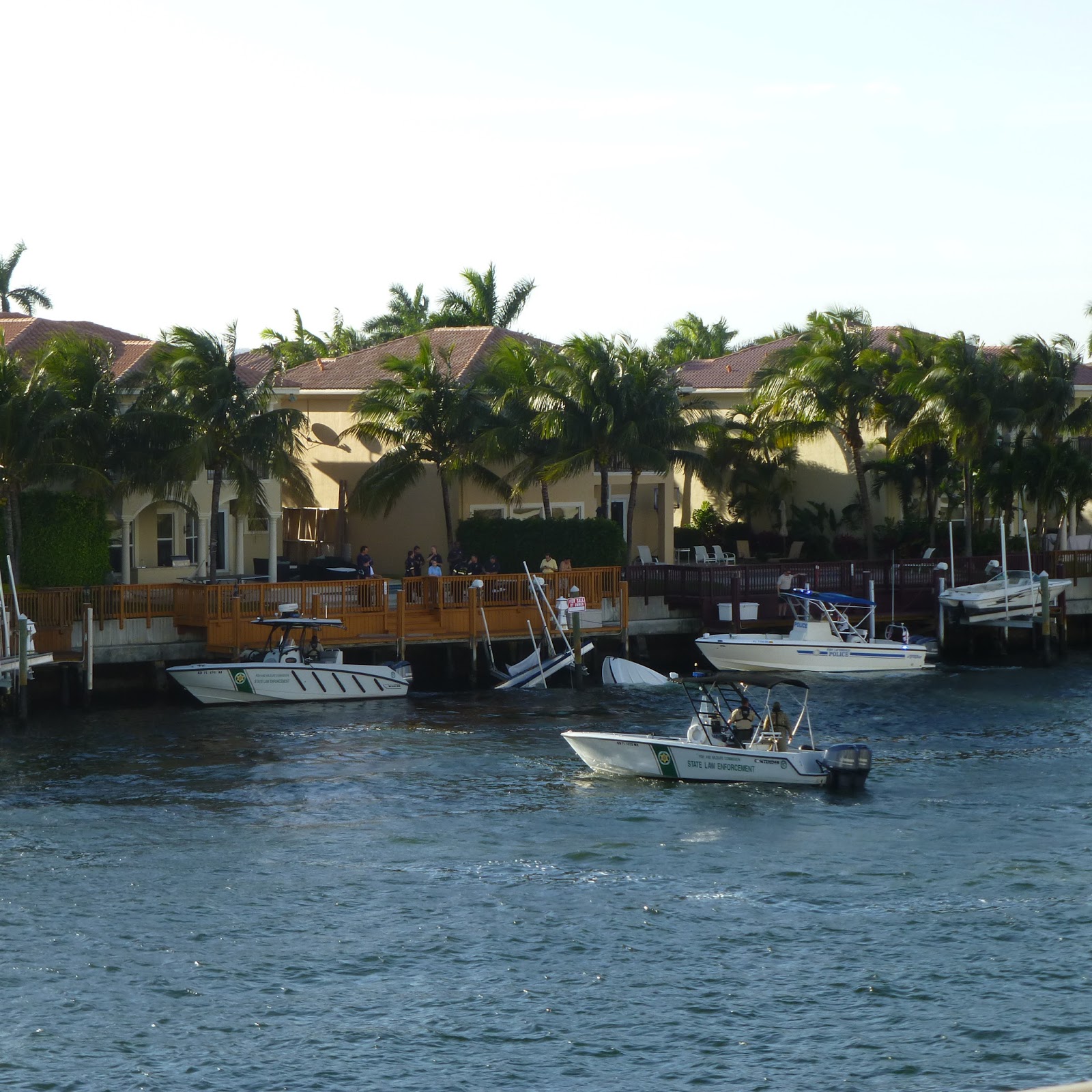
 We also had a little bit of excitement during the last day of my visit. A boat on the other side of the intracoastal had fallen off its raised mooring and sank. We watched while the Fire Rescue, Hollywood Water Police, and Florida Fish and Wildlife officials all came. I won't be there to see how that story works out. Hopefully Alana can fill me in.


 Of course, the cuteness of the Owls trumped all; so I leave you with a few more shots of these little birds.


Tuesday, February 5, 2013

Banding Birds in Seattle

As you know from the previous post, I was in Seattle to visit my son. However, he had tickets for Book of Mormon in Portland, so would be out of town for a couple of days.

Being the best son I have (also the only one), he hooked me up with Emily Runnells, and ornithology major at U. Washington, and a volunteer bander with the Puget Sound Bird Observatory. She picked me up early and we drove out to the Shoreline area in Seattle.

It turns out the banding station is at the head bander's house. Four mist nets were stretched out in her backyard and side yard. Since it was cold out, volunteers were going back to take the birds from the nets every ten minutes.


 Birds were "held" in small cotton sacks and hung on a line in the order in which they had been caught. The team tried to process birds quickly, since they could become hypothermic if exposed to the cold too long without food or movement.


However,  there was a heat lamp and a warming box in case the birds were less than responsive after being banded and processed. I saw two or three birds placed back in their little bags and put in the heating box. After a few minutes you could see their recovery, as they quickly flew off when released.


The first part of processing a bird is the banding. There are several different-sized bands to fit different leg diameters. The idea is to have the band snug enough to stay on and not irritate the bird, but not so snug that it would cause friction or constriction. Each band has a unique identification number which goes into a national database, in case the bird is recaptured or found after it has died.


Once the band is on (in case it escapes before the rest of the data can be recorded), the bird is processed by collecting a variety of data. Below, split between two photos) is the data collection sheet. There is one sheet for each size band, which usually groups the same species of birds on that sheet as well.


 I helped record the data, which became challenging when two or three banders were giving me their birds' information at the same time.


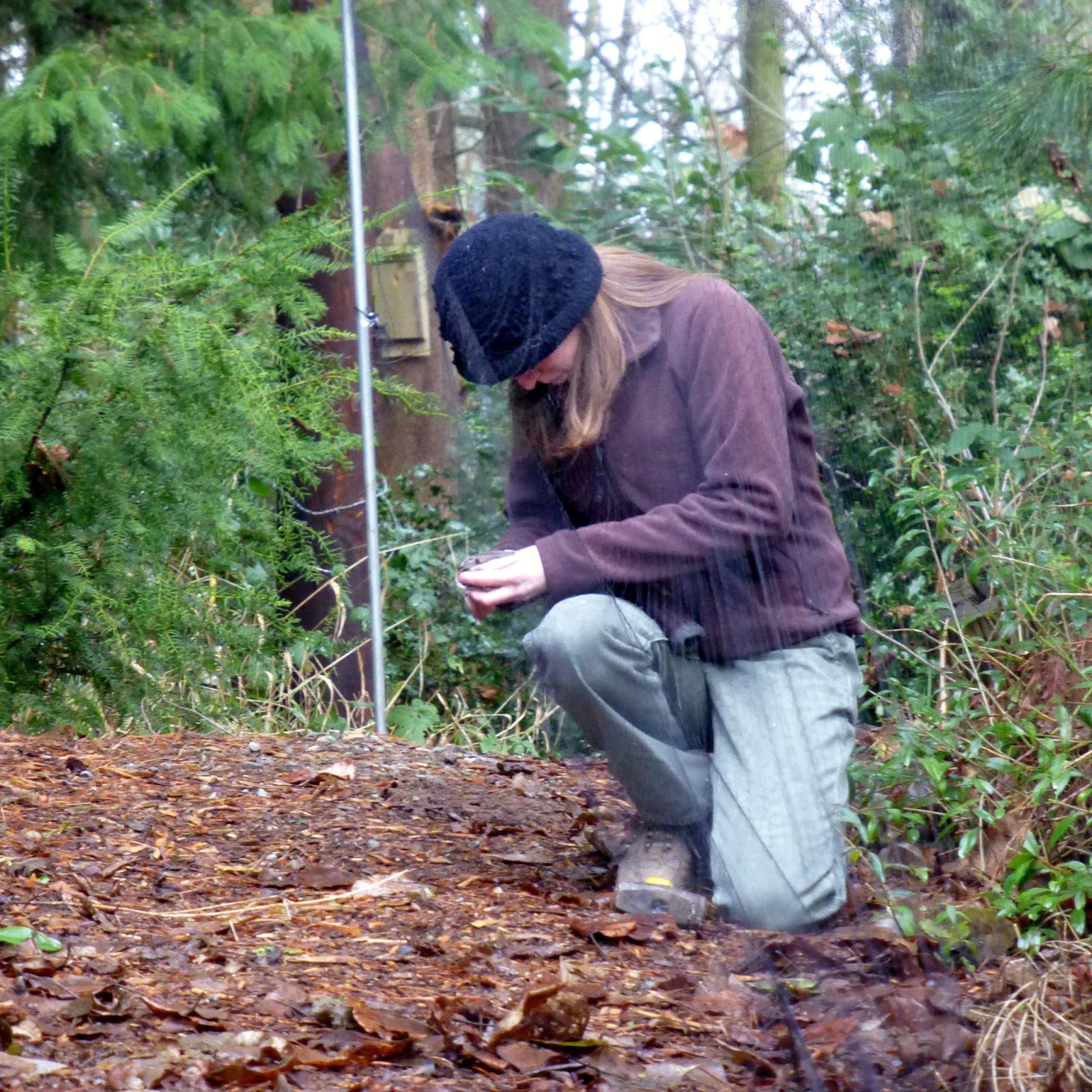
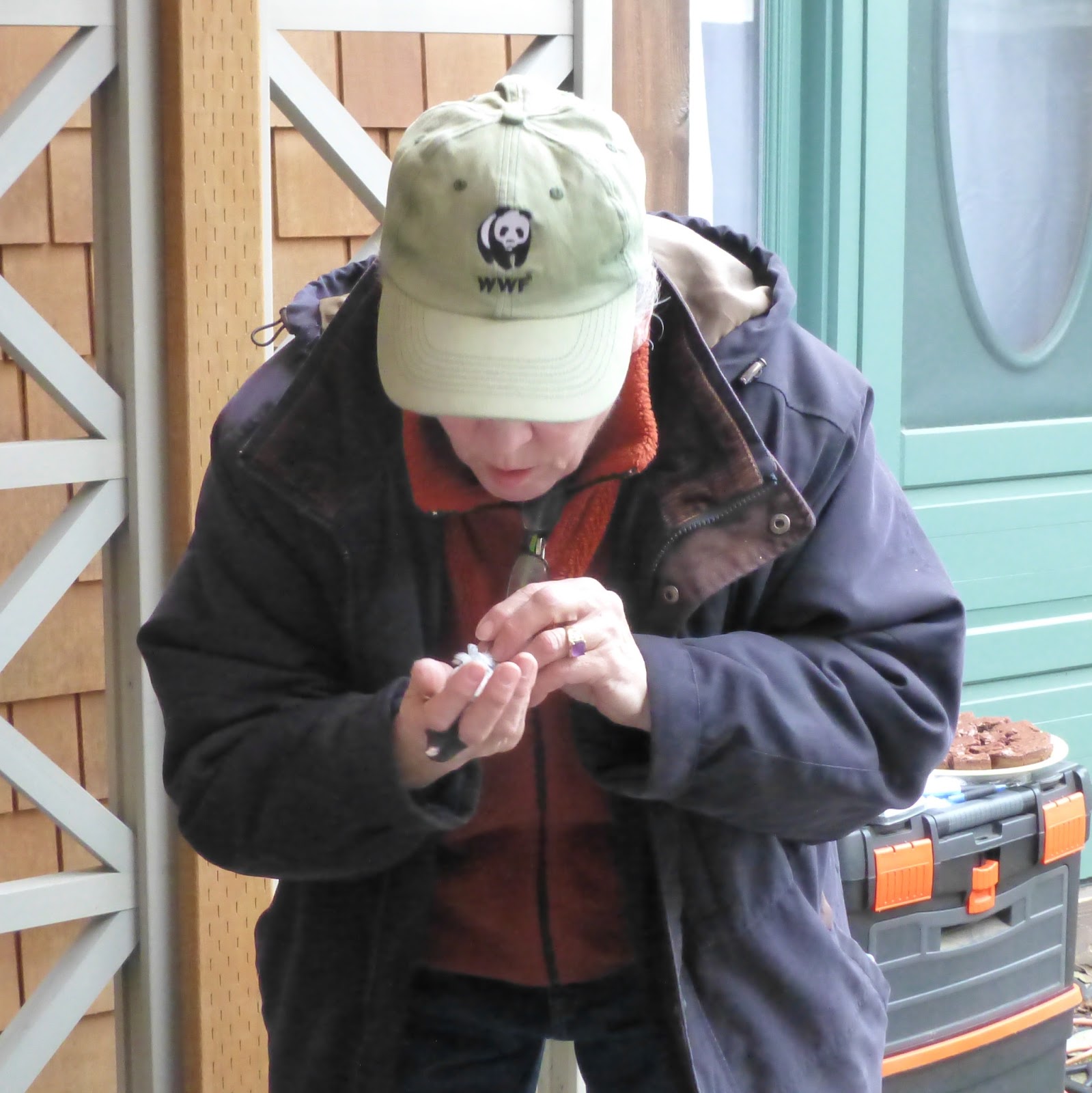
In the above photo, Cathy is blowing on a Dark-eyed Junco's breast feathers to reveal the skin underneath and estimate how much fat the bird has. At the same time she can check it for any parasites.

Below, the Junco reveals some wear in its wing feathers. The second photo shows how the wing should look. Can you tell the difference?


It's also nice to have a close look at the markings on its tail feathers!


Another measurement is the wing chord, the length of the longest primary feather. Here a Pine Siskin is being measured.


As a "thank you" for helping, I got to release a Dark-eyed Junco.


One of the two "best" birds of the day was a Townsend's Warbler. This would have been a life bird for me. However, Avie and I saw one several years ago in Anzalduas Park in the Lower Rio Grande Valley. Nevertheless, she is a beautiful bird and we all turned into paparazzi, snapping plenty of photos before she was released.


A Spotted Towhee was the largest bird we netted. Here's a great look at the "spots".


But, by far, the handsomest bird of the day was this textbook-perfect Red-breasted Nuthatch. The cameras were snapping away with him.


You have to love the detailing on the tail feathers here!

I think all birds look like "Angry Birds" when photographed face on.
 So, a big THANK YOU to my son Dan, for arranging my outing, to Emily, for being my guide and chauffeur, and to lead bander Cathy, for allowing me to join them.