Showing posts with label Texas. Show all posts

Monday, May 13, 2013

Birding Big Bend in Late April

Avie and I have wanted to revisit Big Bend National Park since the Southwest Boogie we took a few years ago. This year it seemed like we had the time and, with our newer Toyota Highlander, the clearance for a visit which would allow us access without endangering our car or our heads. 

We invited our friend Mark along, made reservations at the Big Bend Resort and Adventures in nearby Terlingua (the Chisos Lodge in the park was booked up), and headed off to Big Bend on Friday morning, arriving in the early afternoon.

Driving into the park we were greeted by a desert in bloom. There were flowers of all different colors at all different heights. Quite a change from the last time we were there.


I had used A Field Guide to Birds of the Big Bend by Roland Wauer as a directional beacon for this enormous park. It was a good guide to the optimal birding spots. This was especially important because our time was short, amounting to only two days (an afternoon, a full day, and a morning).

We spent most of our birding time around the Rio Grande Village, nearby Daniels' Ranch, up around the Chisos Mountain Lodge, Cottonwood Campground, and Sam Nail Ranch. The first afternoon we made the mistake of taking the "Nature Trail" by the Rio Grande Village. I really should have known better. However, even though we saw few birds, there were still interesting things to be seen.

The first was a Ground Squirrel busily digging its burrow right off the trail.


 The second was a couple of unattended "shops" set up along the trail. They consisted of a few craft items, a small sign with prices on it, and a jar for the money. There are signs in the park warning you it's illegal to purchase items from vendors who illegally cross over to the U.S. side from Mexico. I imagine this is the vendors' way around the system. You aren't actually purchasing FROM them, since they aren't around. You're simply putting money into a jar in exchange for some found items.


At the Daniels' Ranch area we were forced to contend with a large number of sparrows in the grass. We forged ahead, naming as many as we could and taking photos (albeit not very good ones) of others, which we later worked on over lunch or dinner. I think we got most of them and they're in the trip list at the end of this post.

Of course, there were many birds which were much easier to identify.

Greater Roadrunner

Female Vermilion Flycatcher on Nest

Gray Hawk

Cactus Wren (above) and Lark Bunting (lower right)
Vermilion Flycatcher
Golden-fronted Woodpecker
Say's Phoebe Nest by Chisos Mt. Lodge
Wilson's Warbler
Here's a photo of Avie and Mark. We must have just seen a good bird because they're looking awfully happy!


Below is a photo of a Cactus Wren's nest up by the Chisos Mt. Lodge. They're a rather messy affair. However, they must serve their purpose since we saw several of the Wrens around the park.


Of all the blooms in the desert, I think my favorite were the flowers on the Ocotillos. They're a brilliant orange-red and they tower above the rest of the plants, swaying in the wind.


Our best stop of the trip was at the Sam Nail Ranch, where there's a watermill supplying a water drip to the birds. Water in the desert (or anywhere, for that matter) is always a draw for birds. We had heard the birding there was quite active and there was at least one Varied Bunting there.

The first time we stopped up there a birding tour group had just seen the Bunting and, rather than leave the area quietly and celebrate once they were out of range, they were all giving high fives, sharing their photos, and talking loudly. Needless to say, we saw no birds that particular time.

We returned the next day. It was much quieter and the birds were active. In addition to great looks at Varied Bunting, and we think there were two, we also saw Green-tailed Towhee. Two lifers in an hour isn't too shabby.

Here we are after that successful stop.


Saturday night we went into Terlingua Ghost Town for dinner at the Starlight Restaurant and Theatre. On the way we stopped at the old cemetery. Many of the people there had died during the influenza epidemic during 1919-1920's.


The restaurant was crowded with locals and tourists. The food was quite good and the band was great.


Now for a few filler photos of some interesting and/or beautiful things I was able to photograph.

What's left of the front end of a Scorpion

Unidentified desert blooms

Cholla in bloom
If you want to bird Big Bend (and we WILL be back), I do have some important advice to offer.

  • Always be aware of how much gasoline you have in your tank. Distances in the park are great and the availability of gasoline is sparse.
  • Carry more water than you think you'll need and drink it. You're sweating in the desert, but it's evaporating before you feel it. It's very easy to become dehydrated.
  • Don't count on your cell phone. We had little to no reception in the park and spotty reception elsewhere.
  • Sunscreen! Even better, cover up with long sleeves, light pants, and a hat.
  • Bring layers. The desert might be hot, but up in the mountains it can be quite cool.

Now I leave you with something outside Big Bend. This is a photo of part of a Prairie Dog town just outside Marathon, TX. If you're driving out of Big Bend north, it's on the right side of the road.

And now, The List:

Sunday, November 11, 2012

SA Audubon Field Trip to Choke Canyon

Unfortunately, I forgot the camera today. Of course, there were a couple of great videos I missed. But, such is life.

Since I have no accompanying "illustrations", I'm going to keep this short and sweet. Birding was patchy, with areas of good birding interspersed with long periods of time with no apparent birds or birds giving chip calls, but not allowing us to see them.

The best birding areas today:
  • The parking lot near the swimming pool, giving us Couch's Kingbird, Great Kiskadee, Green Jays, Cooper's Hawk, and both listed Woodpeckers, among others.
  • The first part of the birding trail and then the second section (after the jog and just before where the wetlands used to be), with several Blue-gray Gnatcatchers, Ruby-crowned Kinglets, Yellow-rumped Warblers.
  • 75 Acre Lake, especially scoping the far shores from the trail between the two bodies of water
 The non-birding highlights (which made me yearn for the camera) were:
  • Two Dung Beetles rolling their balls of dung. I love to watch these creatures using their rear legs, while doing their work head down.
  • We heard an unusual noise a bit down the trail. It was coming from a Cottontail Rabbit which had been nabbed by a large Indigo Snake. We watched with morbid fascination while the rabbit struggled and the snake worked against its struggle. I won't go into any more detail. The most interesting thing I saw during the struggle was the snake shaking its tail, as though it was a Rattlesnake. Avie has some video -- we just can't figure out how to get it off his phone.

All in all, not the best of days. But not too shabby either, with 47 species of birds.

Gadwall
Blue-winged Teal
Northern Shoveler
Scaup sp.
Wild Turkey
Neotropic Cormorant
Double-crested Cormorant
Great Blue Heron
Great Egret
Snowy Egret
Little Blue Heron
Tricolored Heron
White Ibis
White-faced Ibis
Roseate Spoonbill
Black Vulture
Turkey Vulture
Osprey
Northern Harrier
Cooper's Hawk
Harris's Hawk
Red-tailed Hawk
Crested Caracara
American Coot
Sandhill Crane
Rock Pigeon
Eurasian Collared-Dove
Golden-fronted Woodpecker
Ladder-backed Woodpecker
Eastern Wood-Pewee
Eastern Phoebe
Vermilion Flycatcher
Great Kiskadee
Couch's Kingbird
Loggerhead Shrike
White-eyed Vireo
Green Jay
Ruby-crowned Kinglet
Blue-gray Gnatcatcher
Northern Mockingbird
European Starling
Yellow-rumped Warbler
Savannah Sparrow
Red-winged Blackbird
Western Meadowlark
Great-tailed Grackle
Brown-headed Cowbird

Monday, September 3, 2012

What We Did on Labor Day Weekend

No picnics. No beach. Avie and I spent yesterday and today mostly communing with nature, with a little Ethiopian food and dining nook/bird viewing spot updating.

The morning was spent at Warbler Woods, a nearby sanctuary in the middle of suburban development. It's always a great stop for birding because Don and Susan Schaezler have created a haven for both resident and migrating birds.

Birding was a bit slow during our time there. But it's always worthwhile when you can sit comfortably and see a Blue-headed Vireo, White-eyed Vireo, Great-crested Flycatcher, and Yellow-breasted Chat, along with other, more common birds mixed in.


Today we spent the morning at the San Antonio Botanical Garden perusing South Texas native plantings. We want to revamp our landscaping at three levels: xeriscaping, wildscaping, mostly native plantings. Here are a few photos of what our front currently looks like during our ongoing drought.


Between St. Augustine grass, a sprinkler-based irrigation system, and that expanse of lawn, I think we can do much better while providing food and shelter for birds, butterflies, and bees, and color and textural interest for ourselves.

We've already selected a landscaping company, Lafield Landscaping. Terri and Rick are excited about working with us and seem to understand what we want, but willing to go outside our desire to eliminate the lawn completely, and give us a more welcoming front with very limited grass (Zoysia rather than St. Augustine).

I took lots of photos at the Botanical Gardens. I tried to stick with native Texas plants. But some non-natives begged to be included in my photos. I'll provide commentary along the way.

This is Yucca nana, but was unmarked in the gardens. I really like it and would like to see if we can work this into the landscape if it meets enough of our criteria. It's not too large and offers some interesting texture.  


 This photo is one species of Zoysia, Zoysia japonica. It's a much softer grass than St. Augustine and requires less water. Terie Lafield insists we need some grass to keep our front from being too hard and unwelcoming. After looking at other people's landscapes, Avie and I have come around to understanding she's correct.


 Next is an Anacacho Orchid Tree (Bauhinia congesta). Apparently, this is one of the best small ornamental trees for the Central and Southern regions of the state. 
 
Anacacho Orchid Tree is moderately fast growing if given regular watering but is also tough enough to withstand extreme drought. Seems like it fits most of our criteria. Just need to check what it offers wildlife.


This silvery low-growing shrub was unmarked throughout the gardens. But it was quite pretty up against greener landscaping as a border planting.


The landscapers intend to use Purple Trailing Lantana in our garden. I know for a fact it's an incredible butterfly magnet, since we already have some.


 What could be more Texas than grasses? Luckily, there are all types available to see at the Gardens. This first one is adorable and I love it -- but I don't think it's native. Rather, I believe it's from the sub-Sahara in Africa. Bummer!


However, Lindheimer's Muhly Grass, which can grow over six feet tall, is native to the Edwards Plateau, exactly where we live! It was all over the Botanical Gardens, so we were able to see it in all different kinds of settings.


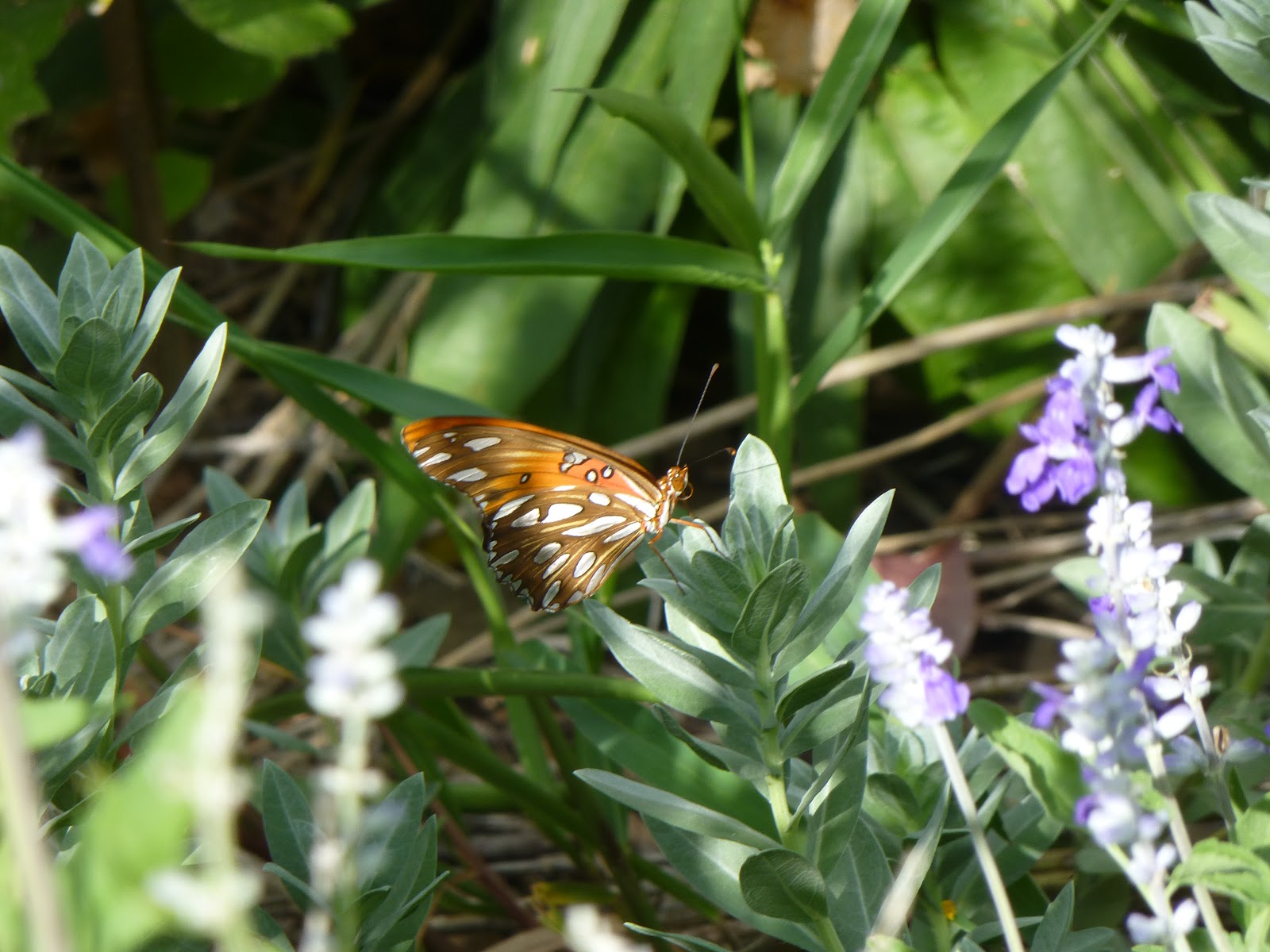
Butterfly break!!!!! (Gulf Fritillary)


Something I would love to do, and I'm debating it with the landscapers, is yank out the ugly hedges in the front of the house and replace them with a mixed hedge we can allow to grow a bit more organically. Suncatcher (with the yellow flowers) is one of the plants I like for that purpose.

I also love the non-native, but very drought resistant and berry producing Dwarf Barbados Cherry, a plant we already have growing as a natural "weed" in our backyard. It's something I'm hoping we could relocate to the front.


Look how pretty the flowers are close up!


Then there are the Yuccas. They'll add both texture, shelter, and flowers for hummingbirds to the garden. The one we see most often around San Antonio is the Red Yucca, with its pink-red flowers on a high stalk.


The Botanical Gardens also had a Twist-Leaf Yucca, native to the Edward Plateau and indicated for limestone hillsides, exactly where we live.


How about a bush growing chiles (Chili Peqin or Capsicum annuum)? Food for both bird and human!


Avie and I have also discussed a type of native grass called Sideoats Grama. We didn't see any at the Botanical Gardens. But they did have Inland Sea Oats, which they indicated was native to Texas. It had seed heads hanging off each plant. They'd be great food for birds and would be very pretty swaying in a breeze.


Bat-faced Cuphea (Cuphea llavea) is another plant our landscaper wants to put around the gardens. It's a very pretty bush with striking bright red and deep purple flowers which resemble a bat's face.


One final plant is Silver Ponyfoot. We're thinking it might look nice as a full-sun border plant along the driveway. It also hangs over rocks nicely, in case we decide to do something like that with raised beds. This photo isn't from the Gardens, but from a Native Plant Center in New Braunfels.


 All in all, the visit to the Gardens made for a great day. We even had a chance to see some birds, such as this juvenile American Robin scratching around the leaf litter for food.


Saturday, September 1, 2012

A Brown Booby at Canyon Lake, TX

Several days ago someone posted he had seen a Brown Booby at Canyon Lake, an inland body of water just north of San Antonio. The sighting was confirmed and the usual litany of posts on the listserve appeared.

"Booby seen perched on dam at 11:00 a.m."

"Booby seen at 3:00 p.m."

"Booby wasn't seen for a while. But then it flew in and we got great views of it."

With a long weekend, slightly cooler weather, and a bird-chasing ambition which is quite unusual for us, Avie and I decided we would drive up to Canyon Lake to see this wayward pelagic bird. We'd already seen the species in Panama. But in South Texas?

We took the back roads up, since driving through Hill Country is always fun and relaxing. Along the way we saw a Crested Caracara wheeling in the sky above us. These birds are usually much more common south of San Antonio. But it seems many south Texas birds are moving north, especially with the extreme drought.

We arrived at the Canyon Lake Dam and saw a large group of birders out on the dam. How did we know they were birders at that distance? Scopes and cameras with really large lenses, of course.

We wandered out. As other birders passed us on their way to exit the area, they nodded at us and told us it was on the far side of the concrete structure on its usual perch. We got to the spot just as the last scope was being packed up and moved out. But the Brown Booby was, indeed, there. One other birder, Gerald Zimmerman from Waxahachie, TX, up by Dallas, remained and we discussed birding, rare birds, and the two other rare birds of late: a Black-tailed Godwit and a Greater Shearwater. (We won't be chasing those.)

We had brought our little Panasonic Lumix camera and zoomed it up as much as possible. I figured I'd try and crop the bird more when we got home. Here's a shot giving a feel for where the bird we in relation to where we were standing:


You can see the Booby perched in the center of the large pole to the right of the concrete structure. We got good looks with our binoculars. Then I zoomed up the camera and cropped the shots even more when I got home. They're a bit "grainy". But show how handsome a Brown Booby is, with its chocolate brown body and contrasting white belly.


Tomorrow morning we're going out to Susan and Don Schaezler's Warbler Woods for a little migratory birding in her backyard. It's the first day of hunting season, so we won't be wandering the property. Still hoping to see some migrating passerines.