Showing posts with label Tel Aviv. Show all posts

Wednesday, August 24, 2011

Israel: A Bit of Urban Birding at HaYarkon Park

Avie and I had been eyeing HaYarkon Park since our arrival to Tel Aviv. It has a river which cuts a swath across the north side of the city, ending with an estuary into the Mediterranean Sea.

We finally made it over to the park the morning of Friday, August 19 and, in spite of being disoriented geographically within the park, were not disappointed.

We went over to the east end of HaYarkon, hoping to be away from the boat/kayak rentals, amusement park, etc. It was busy with bicyclers and a few families, but not enough to be disruptive.

P1150630

The river itself didn’t appear to have many birds in it.

P1150631

We meant to go to an inland pond, but were never able to find it. However, we followed a few of the trails, both paved and dirt, to see what we could see.

Advice to future birders at HaYarkon: always take the high trails. The low ones, meant for bicycling, take you through thick vegetation with little viewing of the water. The paved trails, at least for us, yielded many more birds.

Our first sightings weren’t birds at all, but a couple of lizards. We hadn’t seen but one during our time outside Tel Aviv, so we were excited when two turned up in rapid succession.

P1150634 P1150636

With no new birds for the day, we were able to use our learning curve and were pleased we were able to identify every bird we saw without using our field guide.

The first was  Spur-winged Lapwing (both an adult and a juvenile). We photographed the adult, a handsomely marked bird.

P1150638

Common Myna was, well, common throughout the park. These are not native, but introduced (along with Rose-ringed Parakeets). Apparently, the first tree nesting pair of these used date palms in HaYarkon Park. (Holzapfel, Levin, Hatzofe, & Kark)

P1150643

We were delighted when, toward the end of our walk, we came across a large (maybe a dozen) flock of European Bee Eaters. Some were hawking insects, others were perched together in a tall tree. We couldn’t get a great photo, but managed to get one that shows identifying marks.

P1150645

All in all, we spent about two hours walking and birding. At that point, the heat of the day got to be a bit much, so we gave up.

May I encourage others to visit this urban oasis. I’m sure we would have come across many more birds had we gone earlier or at a cooler time of the year.

THE LIST:

Cattle Egret
Glossy Ibis
Mallard
Spur-winged Lapwing
Rock Pigeon
Laughing Dove
Common Kingfisher
Pied Kingfisher
European Bee Eater
Rose-ringed Parakeet
Syrian Woodpecker
Barn Swallow
White-spectacled Bulbul
Graceful Prinia
Palestine Sunbird
Eurasian Jay
Eurasian Jackdaw
Hooded Crow
Common Myna
House Sparrow

Thursday, August 11, 2011

Two Days in Jerusalem

A photojournal of our two days in Jerusalem. 

Before coming to Israel I was a little skittish about taking public transportation. But taxis are prohibitively expensive, and renting a car is fine, as long as you don't need a parking space (practically nonexistent). 

So, we decided to go with the flow. Our first day to and from Jerusalem we used collective cabs called Monit Sheruts. They don't have a schedule. The depart from their starting point when they fill up, follow a specific route, and are just a hair more expensive than larger buses. We paid 6 shekels each (@ $2US) from our apt. to the central bus station, then 23 shekels each (@ $8US) between Tel Aviv and Jerusalem. The sherut let us off walking distance from the Old City, just off Jaffa Street.


My son's friend Meira, one of his Birthright staffers, met us and accompanied us to the Old City. She recently made aliya to Israel (became a citizen here). In fact, she's the one who took this photo of us on the approach to the Old City.


The streets in the Old City are narrow. Nevertheless, most of them still have cars and minivans driving down them. 

Just before the Kotel (Western Wall of the Temple) there are people instructing male visitors in the specifics of laying Tfillin. You can see them on people's left arms. I'm pretty sure Dan took this photo because of the basketball jerseys.


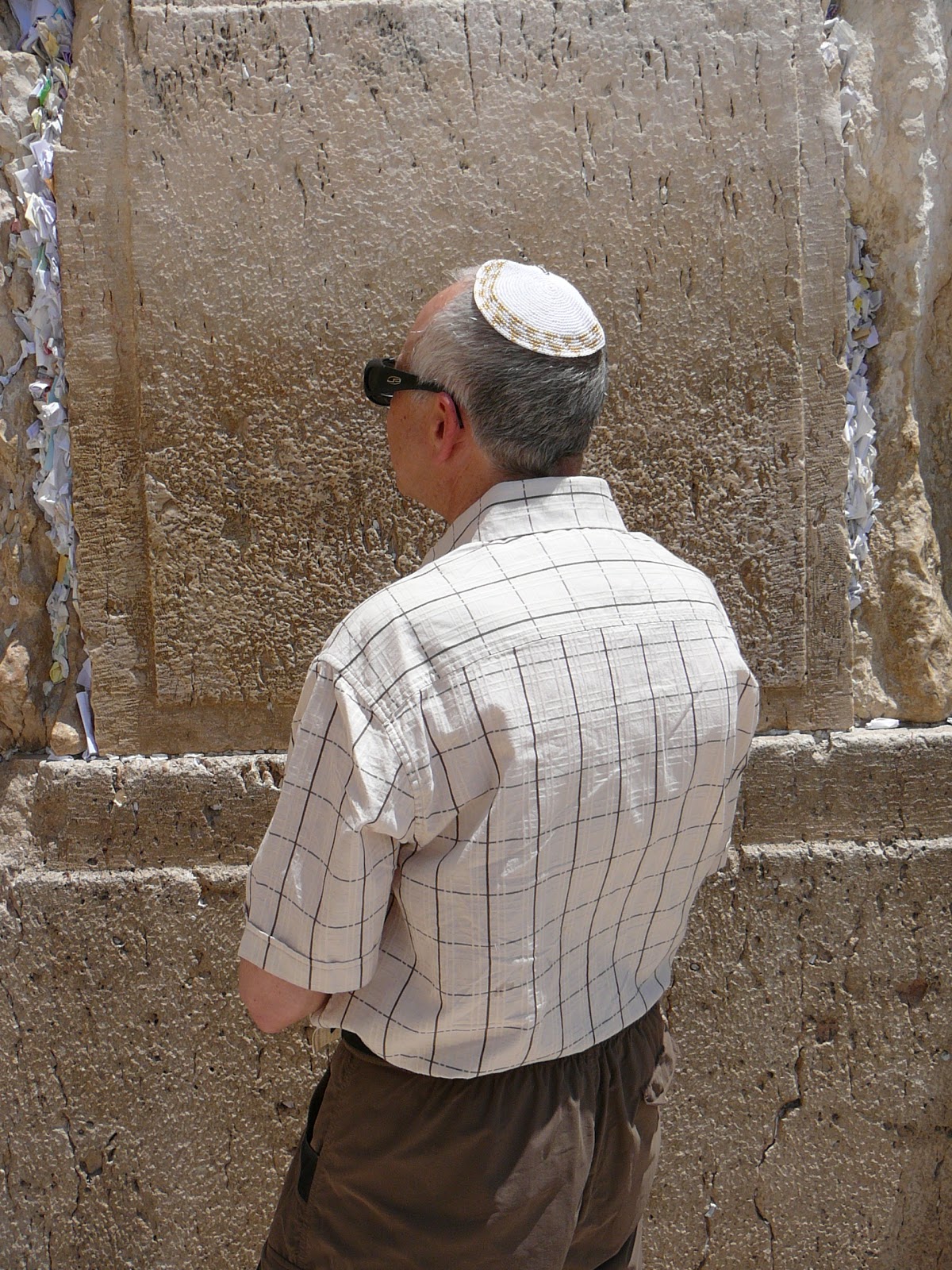
Men and women are not allowed together at the Kotel. So we parted ways. My camera went with the men -- happily so -- otherwise I would not have this photo (taken by Dan) to post here. I believe it captures the aura of the Kotel, one of the world's greatest religious sites.


And another, less emotional photo.


Now for my men at the wall. First Avi, then Dan.


One last photo before we wend our way elsewhere.


After a wonderful lunch of Israeli street food (Chicken shwarma with all sorts of other things, including french fries, wrapped in a huge pita), we headed off to Makhane Yehuda, Jerusalem's market of mostly food. It reminded us a great deal of other food markets around the world. Avi spent a lot of time ogling the mangoes. We finally got one at a nearby Tel Aviv market this evening. I think we're getting many more before we leave!


Before ending our first day in Jerusalem, we passed this building with an interesting sundial. 


We also learned one should never leave anything unattended on the sidewalk. It will cause the street to be cordoned off. The suspicious item will be wired up, covered with a concrete barrier, and detonated on the spot. I have the highest respect for the people in charge of security in Israel! We had a four block detour to reach our Sherut back to Tel Aviv.

Our second day in Jerusalem was going to be spent visiting both Yad Vashem and the Military Cemetery in a different part of the city. Since it would be easier to go through Jerusalem's Central Bus Terminal, we opted to take the larger Egged Co. bus from the Tel Aviv station. After the sherut to the Tel Aviv station, the large bus cost $35 shekels each (@$11US) round trip.

Outside Jerusalem there are beautiful communities built on the tops of hills.


After the bus station, it was one more bus to Yad Vashem. After a short walk up Mt. Herzl (Har Herzl), we arrived.


We were not allowed to carry our backpacks beyond the visitor center, and photos are forbidden in the museums. Let me urge you to visit the museum; it is extremely well curated and incredibly informative. Avi stopped in and looked up his grandparents, who were all murdered in the Holocaust. 

We also visited the Holocaust Art Museum. To me, art speaks even louder than photographs in conveying people's feelings and perceptions. I was sad to see many people not stopping at this great collection of art.

After leaving Yad Vashem, we walked through some of the Jerusalem Forest to the Military Cemetery. Our first stop was the Last of Kin Memorial, dedicated to Holocaust survivors who subsequently died during military service to Eretz Israel.


We also visited the graves of Israel's leaders, including Yitzchak Rabin (and Leah, his wife).


The cemetery is in an incredibly beautiful setting. Of course, birds always catch our eyes. Dan was the first to find a group of Chukar Partridges, a new life bird for our trip. 


On our way out of the cemetery, we stopped at Theodore Herzl's grave. 


We returned to Tel Aviv hungry. Dinner was at the great restaurant on Sheinkin St. where we had lunch on our first day (I really should get the name). Avi had Falafel (AMAZING again), 


and I had something called Beets Cuba. I think it's a bastardization of "Kibbe". It's a Kurdish dish which I thinkwas semolina stuffed with delicately spiced ground beef. It was covered in a light gravy and topped with some golden beets. Of course, the salad was extremely fresh.  


In addition to our son Dan and our daughter Alana, we were also joined by Alana's friend Nahum, a soldier with the Israeli Defense Forces. He was on his way to his sister's for the weekend (Friday and Saturday in Israel).  


We also went to Carmel market to pick up some fruit. Many of the stands were closed or closing, but we managed to pick up some dates, a few peaches, and a huge mango. I took a photo of what a busy market looks like at the end of the day. I wonder who cleans it up?


I'm going to close with an observation. My greatest joy in Israel is not in seeing the sights. It's in experiencing life here. We're staying in a rented apt., not a hotel, so I understand Tel Aviv's tiny kitchens, manual water heaters, open showers, and street cats. We've been using public transportation, so I understand the ease with which people travel in spite of metal detectors and bag inspections. I also know how willing Israelis are to help you when you need directions, even if you don't ask. I've also enjoyed walking the streets, with all its casual encounters and annoyances.

In the shwarma restaurant in Jerusalem a man had half a bottle of soda left after he finished eating. He offered it to us. When we refused, he became more adamant. Then he practically forced us to take it, telling us it was delicious and cold as he poured it into glasses for us. At this point it was impossible to refuse. When we thanked him he gave us a huge smile and said "enjoy!".

Tuesday, August 9, 2011

Just Below the Bauhaus

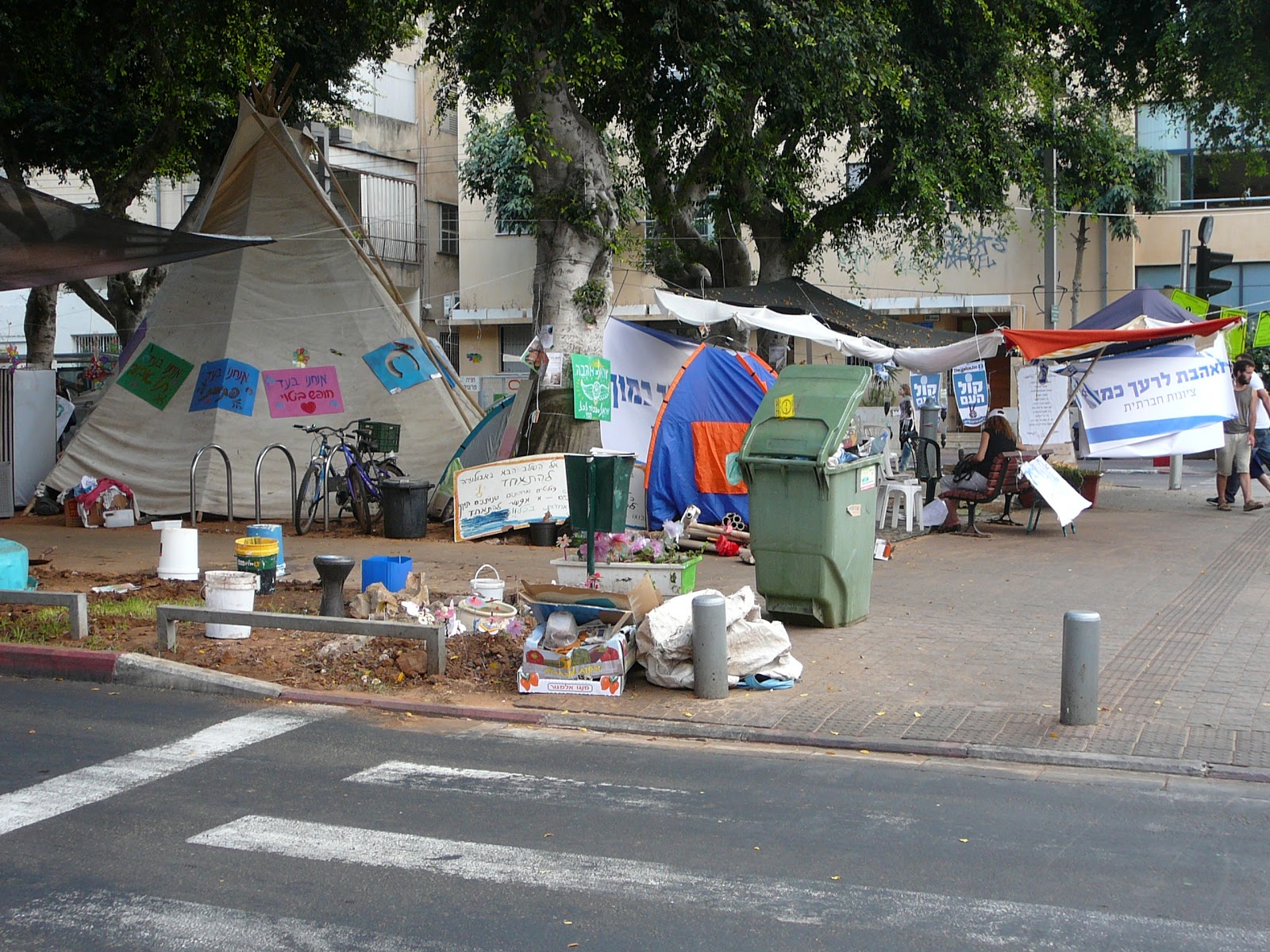
During our walking tour of the Bauhaus architecture on Rothschild, we walked on either side of the long tent city that has sprung up protesting the high cost of housing in Israel. Interestingly, and in contrast to the protests in other countries in this part of the world, it felt a lot less like a protest and a lot more like a Grateful Dead (or Phish) concert.

Most of the tents are identical pop-ups with very little variety. There are signs in Hebrew and English. There are also "schedules" of daily "events" posted. Tonight there's a jam session. We know -- we were invited to attend.

The people we saw are all young. A friend of Dan who lives here told us they're young people out of school for the summer. He also told Dan they are being paid to protest by two lobbying groups. He intimated this is why the majority of tents are all of the same size and make; they were purchased by these groups for the "protest". I have no way of verifying whether this is true or not. But it will be interesting to see how long it lasts.

So, here are a few photos of the "scene" along Rothschild, just below the Bauhaus.


Israel -- At Last!

After years of wishing and hoping, we're finally in Israel. In fact, we've been here a day and a half, racking up 8 life birds. I'm going to take a record of this time and split it into two separate posts, since it will cover two topics -- birding/sightseeing and current events, in that order (though it will appear backwards in the blog).

Arrival at Ben Gurion International Airport was mostly uneventful. We didn't sleep well on our more than comfortable flight, but felt mostly awake and ready to begin our day. We were picked up by our son Dan and Avi's cousin Ika, someone he hasn't seen for many years. My first bird was a Common Blackbird, right on the sidewalk at the airport.

We spent the rest of the morning in Ika's company, visiting his apt. and son Harel at their apt. on the beach at Bat Yam, seeing the senior housing development where he, his wife, and daughter supervise the pool, and sniffing our way to our apt. in Tel Aviv.

Avi and I hit the wall after lunch with the kids at the Carmel Market area, so we came back, took a brief nap, and hung around the apt. while the kids went out on the town with their friends.

This morning we woke up and, while the kids slept, walked over to Rothschild Blvd. to see both the Bauhaus architecture and the tent city protests.

So, to begin with the photographic part of the post, here are photos we were able to get of two of our eight lifers, the first is a Laughing Dove and the second is a Hooded Crow:


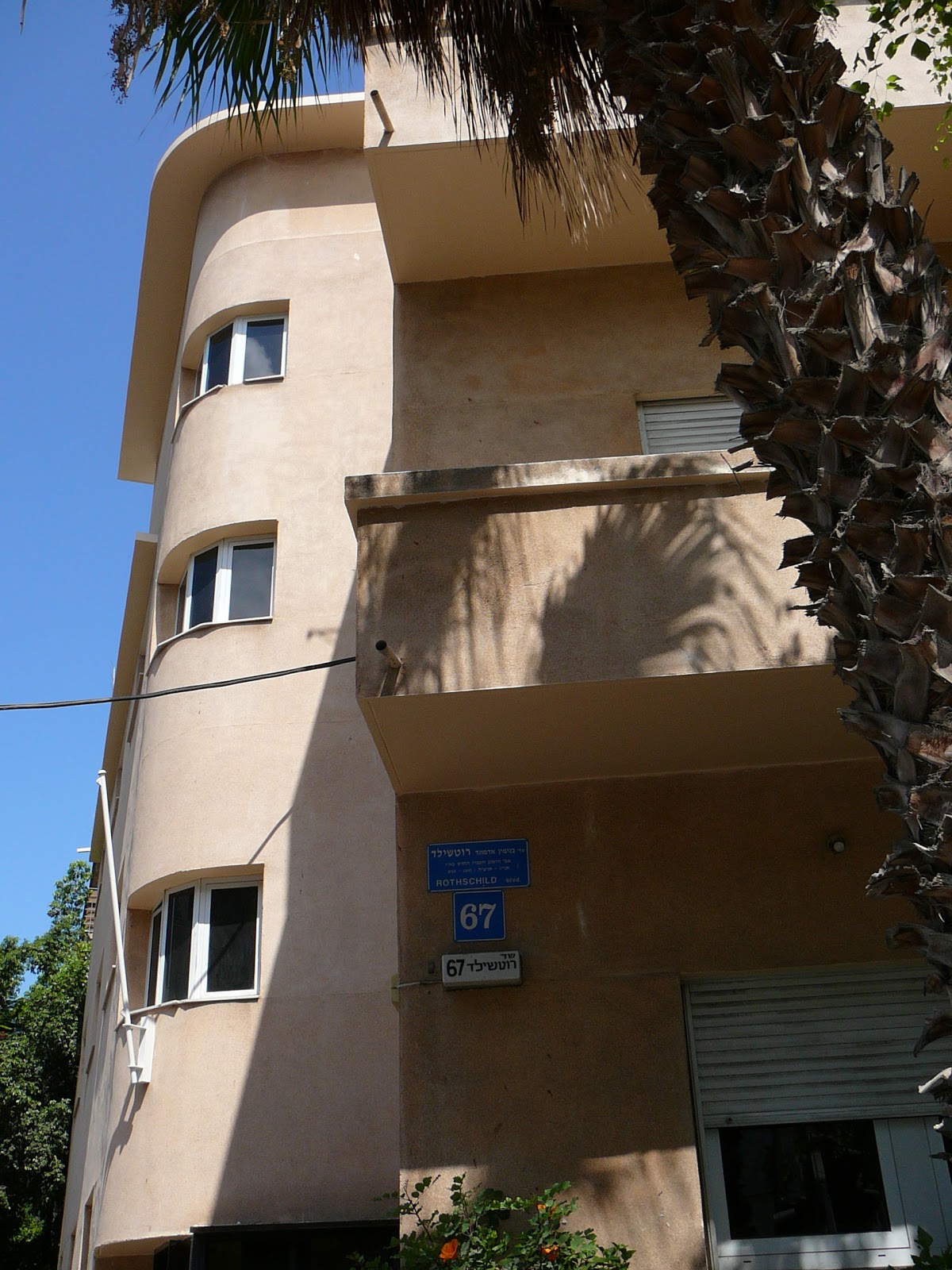
The following series of photos are of different Bauhaus buildings along Rothschild Blvd. They are in various stages of disrepair. One can only hope funds will be found to refurbish them. 


Unfortunately, I don't have specifics on some of them. Where I do, I've prefaced the photos with some information. If I've made any errors, please forgive me. The photos will still give a representative sampling of this wonderful period in Tel Aviv's architectural history. Enjoy!


Ripstein & Co. House (1934) was built as a residential and commercial building with clean-cut cubical contours. Its plain facade preserves the restrained look of the building. The perpendicular effect is induced by the stairwell windows.


The Samuelson House (a three story office building) was originally residential. Built in the cubist style, the wide balconies of the house hover over the boulevard. Its rounded side acts as an interesting contrast on the corner.


The Krieger House (1934) is a three story residential building that has been refurbished. It's built with clean and restrained lines. Its dented balconies, creating a light and shadow effect, are important elements in its design, with their balance between openings and wall. The surface of the white plastered facade protrudes somewhat, while its long narrow openings address Le Corbusier's horizontal ribbon window.


The next few photos are of The Berlin Family House. Built in 1929, it was the private abode of the architect Yoseph Berlin and his wife, the artist and sculptor Shoshana. Yoseph Berlin immigrated to Israel in 1921 and, together with the architect Pasovsky, established the Association of Engineers and Architects. He was one of the first to apply the international style of architecture in Tel Aviv. 

This building, constructed from bare silicate bricks, establish a decorative motif. The surface of the building is an impressive game of light and shade through the use of triangular outcroppings on one of its sides.

Avi also liked the tomato plant someone had growing outside their window.


The statue of three figures, two women and a man with open books in their hands with their mouths open, as though they were speaking, is the work of the sculptor Ofra Zimbalista.


The Hachami House (1933) is a residential building with a single wide facade. Its protruding mass unites all of the stories of the building. One balcony per story cuts across the width of the facade, creating horizontal divisions and preventing the sun from penetrating the rooms. The house was built for David Hachami, founder of the "Israeli Phoenix" insurance company.


The Rapoport House (1934) was being refurbished. But we took photos anyway, since the basic lines of the building remain.